![Macromedia flash 8 [25 May 2017] serial key or number](https://standardservices.com.pk/web/2014/12/dowloads.png?w=300&h=141)
Macromedia flash 8 [25 May 2017] serial key or number
![macromedia flash 8 [25 May 2017] serial key or number](http://qaissaeed.com/wp-content/uploads/2017/11/07-300x206.jpg "macromedia flash 8 [25 May 2017] serial key or number")
macromedia flash 8 [25 May 2017] serial key or number
Adobe Flash Player
 | |||||||||||
| Original author(s) | FutureWave Macromedia | ||||||||||
|---|---|---|---|---|---|---|---|---|---|---|---|
| Developer(s) | Adobe Systems | ||||||||||
| Initial release | January 1, 1996; 24 years ago (January 1, 1996) | ||||||||||
| Stable release(s)[±] | |||||||||||
| |||||||||||
| Preview release(s)[±] | |||||||||||
| |||||||||||
| Written in | C++ | ||||||||||
| Operating system | Windows, macOS, Linux, Chrome OS(current) Solaris, BlackBerry Tablet OS, Android, Pocket PC(discontinued) | ||||||||||
| Platform | Web browsers and ActiveX-based software | ||||||||||
| Available in | Chinese Simplified, Chinese Traditional, English, French, German, Italian, Japanese, Polish, Russian, Portuguese, Spanish, Korean, and Turkish[4] | ||||||||||
| Type | Runtime system and browser extension | ||||||||||
| License | Freeware | ||||||||||
| Website | adobe.com/products/flashplayer.html | ||||||||||
Adobe Flash Player (labeled Shockwave Flash in Internet Explorer, Firefox, and Google Chrome)[5] is computer software for using content created on the Adobe Flash platform, including viewing multimedia contents, executing rich Internet applications, and streaming audio and video. Flash Player can run from a web browser as a browser plug-in or on supported mobile devices. Flash Player was created by Macromedia and has been developed and distributed by Adobe Systems since Adobe acquired Macromedia in 2005. Flash Player is distributed as freeware.
Flash Player runs SWF files that can be created by Adobe Flash Professional, Adobe Flash Builder or by third party tools such as FlashDevelop. Flash Player supports vector graphics, 3D graphics, embedded audio, video and raster graphics, and a scripting language called ActionScript. ActionScript is based on ECMAScript (similar to JavaScript) and supports object-oriented code. Flash Player is distributed free of charge and its plug-in versions are available for every major web browser and operating system. Google Chrome, Internet Explorer 11, in Windows 8 and later, and Microsoft Edge come bundled with a sandboxed Adobe Flash plug-in.[6][7][8][9][10]
Flash Player once had a large user base, and was a common format for web games, animations, and graphical user interface (GUI) elements embedded in web pages. Adobe stated in 2013 that more than 400 million out of over 1 billion connected desktops update to the new version of Flash Player within six weeks of release.[11] However, Flash Player has become increasingly criticized for its performance, consumption of battery on mobile devices, the number of security vulnerabilities that had been discovered in the software, and its closed platform nature. Apple co-founder Steve Jobs was highly critical of Flash Player, having published an open letter detailing Apple's reasoning for not supporting Flash on its iOS device family. Its usage has also waned because of modern web standards that allow some of Flash's use cases to be fulfilled without third-party plugins.[12][13][14]
In July 2017, Adobe announced[15] that it will end support for Flash Player on December 31, 2020, and continued to encourage the use of open HTML5 standards in place of Flash.[16][17] The announcement was coordinated with Apple,[18]Facebook,[19]Google,[20]Microsoft,[21] and Mozilla.[22] In September 2019, Microsoft announced that on December 31, 2020, Flash will be entirely removed from all browsers via Windows Update.[23]
Features[edit]
Adobe Flash Player is a runtime that executes and displays content from a provided SWF file, although it has no in-built features to modify the SWF file at runtime. It can execute software written in the ActionScript programming language which enables the runtime manipulation of text, data, vector graphics, raster graphics, sound, and video. The player can also access certain connected hardware devices, including the web cameras and microphones, after permission for the same has been granted by the user.
Flash Player is used internally by the Adobe Integrated Runtime (AIR), to provide a cross-platform runtime environment for desktop applications and mobile applications. AIR supports installable applications on Windows, Linux, macOS, and some mobile operating systems such as iOS and Android. Flash applications must specifically be built for the AIR runtime to use additional features provided, such as file system integration, native client extensions, native window/screen integration, taskbar/dock integration, and hardware integration with connected Accelerometer and GPS devices.[24]
Data formats[edit]
Flash Player includes native support for many data formats, some of which can only be accessed through the ActionScript scripting interface.
- XML: Flash Player has included native support for XML parsing and generation since version 8. XML data is held in memory as an XML Document Object Model, and can be manipulated using ActionScript. ActionScript 3 also supports ECMAScript for XML (E4X), which allows XML data to be manipulated more easily.
- JSON: Flash Player 11 includes native support for importing and exporting data in the JavaScript Object Notation (JSON) format, which allows interoperability with web services and JavaScript programs.
- AMF: Flash Player allows application data to be stored on users computers, in the form of Local Shared Objects, the Flash equivalent to browser cookies.[25] Flash Player can also natively read and write files in the Action Message Format, the default data format for Local Shared Objects. Since the AMF format specification is published, data can be transferred to and from Flash applications using AMF datasets instead of JSON or XML, reducing the need for parsing and validating such data.
- SWF: The specification for the SWF file format was published by Adobe, enabling the development of the SWX Format project, which used the SWF file format and AMF as a means for Flash applications to exchange data with server side applications.[26][27] The SWX system stores data as standard SWF bytecode which is automatically interpreted by Flash Player.[28] Another open-source project, SWXml allows Flash applications to load XML files as native ActionScript objects without any client-side XML parsing, by converting XML files to SWF/AMF on the server.[29][30]
Multimedia formats[edit]
Flash Player is primarily a graphics and multimedia platform, and has supported raster graphics and vector graphics since its earliest version. It supports the following different multimedia formats which it can natively decode and play back.
- MP3: Support for decoding and playback of streamingMPEG-2 Audio Layer III (MP3) audio was introduced in Flash Player 4. MP3 files can be accessed and played back from a server via HTTP, or embedded inside an SWF file, which is also a streaming format.
- FLV: Support for decoding and playing back video and audio inside Flash Video (FLV and F4V) files, a format developed by Adobe Systems and Macromedia. Flash Video is only a container format and supports multiple different video codecs, such as Sorenson Spark, VP6, and more recently H.264.[31] Flash Player uses hardware acceleration to display video where present, using technologies such as DirectX Video Acceleration and OpenGL to do so. Flash Video is used by YouTube,[32]Hulu,[33]Yahoo! Video, BBC Online,[34] and other news providers. FLV files can be played back from a server using HTTPprogressive download, and can also be embedded inside an SWF file. Flash Video can also be streamed via RTMP using the Adobe Flash Media Server or other such server-side software.
- PNG: Support for decoding and rendering Portable Network Graphics (PNG) images, in both its 24-bit (opaque) and 32-bit (semi-transparent) variants. Flash Player 11 can also encode a PNG bitmap via ActionScript.
- JPEG: Support for decoding and rendering compressed JPEG images. Flash Player 10 added support for the JPEG-XR advanced image compression standard developed by Microsoft Corporation, which results in better compression and quality than JPEG. JPEG-XR enables lossy and lossless compression with or without alpha channel transparency. Flash Player 11 can also encode a JPEG or JPEG-XR bitmap via ActionScript.
- GIF: Support for decoding and rendering compressed Graphics Interchange Format (GIF) images, in its single-frame variants only. Loading a multi-frame GIF will display only the first image frame.
Streaming protocols[edit]
- HTTP: Support for communicating with web servers using HTTP requests and POST data.[35] However, only websites that explicitly allow Flash to connect to them can be accessed via HTTP or sockets, to prevent Flash being used as a tool for cross-site request forgery,[36]cross-site scripting, DNS rebinding,[37] and denial-of-service attacks. Websites must host a certain XML file termed a cross domain policy,[37] allowing or denying Flash content from specific websites to connect to them. Certain websites, such as Digg, Flickr, and Photobucket already host a cross domain policy that permits Flash content to access their website via HTTP.[38]
- RTMP: Support for live audio and video streaming using the Real Time Messaging Protocol (RTMP) developed by Macromedia. RTMP supports a non-encrypted version over the Transmission Control Protocol (TCP) or an encrypted version over a secure Transport Layer Security (SSL) connection. RTMPT can also be encapsulated within HTTP requests to traverse firewalls that only allow HTTP traffic.
- TCP: Support for Transmission Control Protocol (TCP) Internet socket communication to communicate with any type of server, using stream sockets. Sockets can be used only via ActionScript, and can transfer plain text, XML, or binary data (ActionScript 3.0 and later).[39][40] To prevent security issues, web servers that permit Flash content to communicate with them using sockets must host an XML-based cross domain policy file, served on Port 843.[41] Sockets enable AS3 programs to interface with any kind of server software, such as MySQL.[42]
Performance[edit]
Hardware acceleration[edit]
Until version 10 of the Flash player, there was no support for GPU acceleration. Version 10 added a limited form of support for shaders on materials in the form of the Pixel Bender API, but still did not have GPU-accelerated 3D vertex processing.[43] A significant change came in version 11, which added a new low-level API called Stage3D (initially codenamed Molehill), which provides full GPU acceleration, similar to WebGL.[44][45] (The partial support for GPU acceleration in Pixel Bender was completely removed in Flash 11.8, resulting in the disruption of some projects like MIT's Scratch, which lacked the manpower to recode their applications quickly enough.[46][47])
Current versions of Flash Player are optimized to use hardware acceleration for video playback and 3D graphics rendering on many devices, including desktop computers. Performance is similar to HTML5 video playback.[48][49] Also, Flash Player has been used on multiple mobile devices as a primary user interface renderer.[50]
Compilation[edit]
Although code written in ActionScript 3 executes up to 10 times faster than the prior ActionScript 2,[51] the Adobe ActionScript 3 compiler is a non-optimizing compiler, and produces inefficient bytecode in the resulting SWF, when compared to toolkits such as CrossBridge.[52][53][54][55][56]
CrossBridge, a toolkit that targets C++ code to run within the Flash Player, uses the LLVM compiler to produce bytecode that runs up to 10 times faster than code the ActionScript 3 compiler produces, only because the LLVM compiler uses more aggressive optimization.[54][55][56]
Adobe has released ActionScript Compiler 2 (ASC2) in Flex 4.7 and onwards, which improves compilation times and optimizes the generated bytecode and supports method inlining, improving its performance at runtime.[57]
As of 2012, the Haxe multiplatform language can build programs for Flash Player that perform faster than the same application built with the Adobe Flex SDK compiler.[58][unreliable source?]
Development methods[edit]
Flash Player applications and games can be built in two significantly different methods:
- "Flex" applications: The Adobe Flex Framework is an integrated collection of stylable Graphical User Interface, data manipulation and networking components, and applications built upon it are termed "Flex" applications. Startup time is reduced since the Flex framework must be downloaded before the application begins, and weighs in at approximately 500KB. Editors include Adobe Flash Builder and FlashDevelop.
- "Pure ActionScript" applications: Applications built without the Flex framework allow greater flexibility and performance.[59][60][61] Video games built for Flash Player are typically pure-Actionscript projects. Various open-source component frameworks are available for pure ActionScript projects, such as MadComponents, that provide UI Components at significantly smaller SWF file sizes.[62][63]
In both methods, developers can access the full Flash Player set of functions, including text, vector graphics, bitmap graphics, video, audio, camera, microphone, and others. AIR also includes added features such as file system integration, native extensions, native desktop integration, and hardware integration with connected devices.
Development tools[edit]
Adobe provides five ways of developing applications for Flash Player:
Third-party development environments are also available:
Game development[edit]
Adobe offers the free Adobe Gaming SDK, consisting (as of August 2014[update]) of several open-source AS3 libraries built on the Flash Player Stage3D APIs for GPU-accelerated graphics:[66]
- Away3D: GPU-accelerated 3D graphics and animation engine
- Starling: GPU-accelerated 2D graphics that mimics the Flash display list API
- Feathers: GPU-accelerated skinnableGUI library built on top of Starling
- Dragon Bones: GPU-accelerated 2D skeletal animation library
A few commercial game engines target Flash Player (Stage3D) as run-time environment, such as Unity 3D[67] and Unreal Engine 3.[67][68] Before the introduction of Stage3D, a number of older 2D engines or isometric engines like Flixel saw their heyday.[69]
Adobe also developed the CrossBridge toolkit which cross-compilesC/C++ code to run within the Flash Player, using LLVM and GCC as compiler backends, and high-performance memory-accessopcodes in the Flash Player (termed "Domain Memory") to work with in-memory data quickly.[70] CrossBridge is targeted toward the game development industry,[71] and includes tools for building, testing, and debugging C/C++ projects in Flash Player.
Notable online video games developed in Flash include Angry Birds, FarmVille, and AdventureQuest (started in 2002, and still active as of 2011).[72]
Availability[edit]
Desktop platforms[edit]
The latest version of Flash Player is available for Windows XP SP2+ and later, Mac OS X 10.6 and later and Linux.
Adobe Flash Player is available in four flavors:
- The "Internet Explorer – ActiveX" version is an ActiveX control for use in Internet Explorer, its shells, and other Windows applications that support ActiveX technology. This plugin cannot be installed on Windows 8 and later, because these OSes come with their own integrated Flash Player ActiveX.
- The "Firefox – NPAPI" version is available for Firefox as well as other applications that support NPAPI technology.
- The "Opera and Chromium – PPAPI" version is available for Chromium and browsers based on Chromium (such as Opera) as well as other applications that support PPAPI technology. This plugin cannot be installed on Google Chrome as it comes with its own built-in Flash component.
- The "projector" version is a standalone player that can open SWF files directly.[73]
On February 22, 2012, Adobe announced that it would no longer release new versions of NPAPI Flash plugins for Linux, although Flash Player 11.2 would continue to receive security updates.[74][75][76] In August 2016 Adobe announced that, beginning with version 24, it will resume offering of Flash Player for Linux for other browsers.[77]
The Extended Support Release (ESR) of Flash Player on macOS and Windows was a version of Flash Player kept up to date with security updates, but none of the new features or bug fixes available in later versions. It has been on version 11.7 as of July 9, 2013,[78] version 13 as of May 13, 2014,[79] and version 18 as of August 11, 2015.[80] Adobe has decided to discontinue the ESR branch and instead focus solely on the standard release as of August 2016.[81]
Mobile platforms[edit]
In 2011, Flash Player had emerged as the de facto standard for online video publishing on the desktop, with adaptive bitrate video streaming, DRM, and fullscreen support.[32][33] On mobile devices however, after Apple refused to allow the Flash Player within the inbuilt iOS web browser, Adobe changed strategy, enabling Flash content to be delivered as native mobile applications using the Adobe Integrated Runtime.
Up until 2012, Flash Player 11 was available for the Android (ARM Cortex-A8 and above),[85][86] although in June 2012, Google announced that Android 4.1 (codenamed Jelly Bean) would not support Flash by default. Starting in August 2012, Adobe no longer updates Flash for Android.[87] In spite of this, Adobe Flash is still available to install on Android devices via Adobe's update archives (up to Android 4.3).
Flash Player is certified to be supported on a select range of mobile and tablet devices, from Acer, BlackBerry 10, Dell, HTC, Lenovo, Logitech, LG, Motorola, Samsung, Sharp, SoftBank, Sony (and Sony Ericsson), and Toshiba.[88][89][90] As of 2012, Adobe has stopped browser-based Flash Player development for mobile browsers in favor of HTML5,[91][92] however Adobe continues to support Flash content on mobile devices with the Adobe Integrated Runtime, which allows developers to publish content that runs as native applications on certain supported mobile phone platforms.
Version 9 was the most recent version available for the Linux/ARM-based Nokia 770/N800/N810 Internet tablets running Maemo OS2008, classic Mac OS and Windows 95/NT.[93] Version 10 can be run under Windows 98/Me using KernelEx. HP offered Version 6 of the player for HP-UX.[94] Other versions of the player have been available at some point for OS/2, Symbian OS, Palm OS, BeOS, and IRIX.[95] The Kodak Easyshare One includes Flash Player.[96]
Adobe said it will optimize Flash for use on ARM architecture (ARMv7 and ARMv6 architectures used in the Cortex-A series of processors and in the ARM11 family) and release it in the second half of 2009. The company also stated it wants to enable Flash on NVIDIA Tegra, Texas Instruments OMAP 3, and Samsung ARMs.[97][98] Beginning 2009, it was announced that Adobe would be bringing Flash to TV sets via Intel Media Processor CE 3100 before mid-2009.[99]ARM Holdings later said it welcomes the move of Flash, because "it will transform mobile applications and it removes the claim that the desktop controls the Internet."[100] However, as of May 2009, the expected ARM/Linux netbook devices had poor support for Web video and fragmented software base.[101]
Among other devices, LeapFrog Enterprises provides Flash Player with their Leapster Multimedia Learning System and extended the Flash Player with touch-screen support.[102] Sony has integrated Flash Player 6 into the PlayStation Portable's web browser via firmware version 2.70 and Flash Player 9 into the PlayStation 3's web browser in firmware version 2.50.[103]Nintendo has integrated Flash Lite 3.1, equivalent to Flash 8, in the Internet Channel on the Wii.
The following table documents historical support for Flash Player and AIR on mobile operating systems:
Other hardware[edit]
Some CPU emulators have been created for Flash Player, including Chip8,[115]Commodore 64,[116]ZX Spectrum,[117] and the Nintendo Entertainment System.[118] They enable video games created for such platforms to run within Flash Player.
Open source[edit]
Adobe has taken steps to reduce or eliminate Flash licensing costs. For instance, the SWF file format documentation is provided free of charge[119] after they relaxed the requirement of accepting a non-disclosure agreement to view it in 2008.[120] Adobe also created the Open Screen Project which removes licensing fees and opens data protocols for Flash.
Adobe has also open-sourced many components relating to Flash.
Adobe has not been willing to make complete source code of the Flash Player available for free software development and even though free and open source alternatives such as Shumway and Gnash have been built, they are no longer under active development.[129] The only fully functional third-party Flash Player is the commercially available Scaleform GFx Player, which is game development middleware designed for integration into non-Flash video games.[citation needed]
Criticism[edit]
Usability[edit]
In some browsers, prior Flash versions have had to be uninstalled before an updated version could be installed.[130][131] However, as of version 11.2 for Windows, there are now automatic updater options.[132] Linux is partially supported, as Adobe is cooperating with Google to implement it via Chrome web browser on all Linux platforms.[133]
Mixing Flash applications with HTML leads to inconsistent behavior with respect to input handling (keyboard and mouse not working as they would in an HTML-only document). This is often done in web sites[134] and can lead to poor user experience with the site.
The February 20, 2014 update to 12.0.0.70 introduced a reported bug, producing green video with sound only. This defect is related to hardware acceleration and may be overcome by disabling hardware acceleration via the Adobe settings in Firefox (accessed by right clicking within the video) or in Internet Explorer (within the Tools settings).[135] This defect may be related to widely used graphics hardware, AMD Radeon HD video cards, and similar visual defects have occurred in earlier Flash updates, with the same workaround.
Privacy[edit]
Flash Player supports persistent local storage of data (also referred to as Local Shared Objects), which can be used similarly to HTTP cookies or Web Storage in web applications. Local storage in Flash Player allows websites to store non-executable data on a user's computer, such as authentication information, game high scores or saved games, server-based session identifiers, site preferences, saved work, or temporary files. Flash Player will only allow content originating from exactly the same website domain to access data saved in local storage.[136]
Because local storage can be used to save information on a computer that is later retrieved by the same site, a site can use it to gather user statistics, similar to how HTTP cookies and Web Storage can be used. With such technologies, the possibility of building a profile based on user statistics is considered by some a potential privacy concern. Users can disable or restrict use of local storage in Flash Player through a "Settings Manager" page.[137][138] These settings can be accessed from the Adobe website or by right-clicking on Flash-based content and selecting "Global Settings".
Local storage can be disabled entirely or on a site-by-site basis. Disabling local storage will block any content from saving local user information using Flash Player, but this may disable or reduce the functionality of some websites, such as saved preferences or high scores and saved progress in games.
Flash Player 10.1 and upward honor the privacy mode settings in the latest versions of the Chrome, Firefox, Internet Explorer, and Safari web browsers, such that no local storage data is saved when the browser's privacy mode is in use.[139]
Security[edit]
Adobe security bulletins and advisories announce security updates, but Adobe Flash Player release notes do not disclose the security issues addressed when a release closes security holes, making it difficult to evaluate the urgency of a particular update. A version test page allows the user to check if the latest version is installed, and uninstallers may be used to ensure that old-version plugins have been uninstalled from all installed browsers.
In February 2010, Adobe officially apologized[140] for not fixing a known vulnerability for over a year. In June 2010 Adobe announced a "critical vulnerability" in recent versions, saying there are reports that this vulnerability is being actively exploited in the wild against both Adobe Flash Player, and Adobe Reader and Acrobat.[141][142] Later, in October 2010, Adobe announced[143] another critical vulnerability, this time also affecting Android-based mobile devices. Android users have been recommended to disable Flash or make it only on demand.[144] Subsequent security vulnerabilities also exposed Android users, such as the two critical vulnerabilities published in February 2013[145] or the four critical vulnerabilities published in March 2013,[146] all of which could lead to arbitrary code execution.
Symantec's Internet Security Threat Report[147] states that a remote code execution in Adobe Reader and Flash Player[148] was the second most attacked vulnerability in 2009. The same report also recommended using browser extensions to disable Flash Player usage on untrusted websites. McAfee predicted that Adobe software, especially Reader and Flash, would be primary target for attacks in 2010.[149] Adobe applications had become, at least at some point, the most popular client-software targets for attackers during the last quarter of 2009.[150] The Kaspersky Security Network published statistics for the third quarter of 2012 showing that 47.5% of its users were affected by one or more critical vulnerabilities.[151] The report also highlighted that "Flash Player vulnerabilities enable cybercriminals to bypass security systems integrated into the application."[151]
Steve Jobs criticized the security of Flash Player, noting that "Symantec recently highlighted Flash for having one of the worst security records in 2009".[152] Adobe responded by pointing out that "the Symantec Global Internet Threat Report for 2009, found that Flash Player had the second lowest number of vulnerabilities of all Internet technologies listed (which included both web plug-ins and browsers)."[153][154]
On April 7, 2016, Adobe released a Flash Player patch for a zero-day memory corruption vulnerability CVE-2016-1019 that could be used to deliver malware via the Magnitude exploit kit. The vulnerability could be exploited for remote code execution.[155][156]
Vendor lock-in[edit]
Flash Player 11.2 does not play certain kinds of content unless it has been digitally signed by Adobe, following a license obtained by the publisher directly from Adobe.[157]
This move by Adobe, together with the abandonment of Flex to Apache was criticized as a way to lock out independent tool developers, in favor of Adobe's commercial tools.[158][159][160]
This has been resolved as of January 2013, after Adobe no longer requires a license or royalty from the developer. All premium features are now classified as general availability, and can be freely used by Flash applications.[161]
Apple controversy[edit]
In April 2010, Steve Jobs, at the time CEO of Apple Inc. published an open letter explaining why Apple would not support Flash on the iPhone, iPod touch, and iPad.[152] In the letter he blamed problems with the "openness", stability, security, performance, and touchscreen integration of the Flash Player as reasons for refusing to support it. He also claimed that when one of Apple's Macintosh computers crashes, "more often than not" the cause can be attributed to Flash, and described Flash as "buggy".[162] Adobe's CEO Shantanu Narayen responded by saying, "If Flash [is] the number one reason that Macs crash, which I'm not aware of, it has as much to do with the Apple operating system."[163]
Steve Jobs also claimed that a large percentage of the video on the Internet is supported on iOS, since many popular video sharing websites such as YouTube have published video content in an HTML5 compatible format, enabling videos to playback in mobile web browsers even without Flash Player.[164]
China-specific version[edit]
Starting with version 30, Adobe stopped distributing Flash Player directly to Chinese users. Instead, they selected 2144.cn as a partner and released a special version of Flash Player on a specific website,[165] which contains a non-closable process that collects privacy information and pops up advertisement window contents.[166][167][168] The partnership started in about 2017, but in version 30, Adobe disabled the usage of vanilla (global) version of Flash Player in China,[169] forcing users to use that specific version, which may pose a risk to its users due to China's Internet censorship.[170] This affects Google Chrome users using Windows 10, Internet Explorer users using Windows 7, and Firefox users using all versions of Windows, as Microsoft still directly distributes Flash Player for Internet Explorer and Microsoft Edge through Windows Update in Windows 8 and upward.
Release history[edit]
- Mostly vectors and motion, some bitmaps, limited audio
- Support of stereo sound, enhanced bitmap integration, buttons, the Library, and the ability to tween color changes
- Macromedia Flash Player 3 (May 31, 1998)
- Added alpha transparency, licensed MP3 compression
- Brought improvements to animation, playback, and publishing, as well as the introduction of simple script commands for interactivity
- Macromedia Flash Player 4 (June 15, 1999)
- Saw the introduction of streaming MP3s and the Motion Tween. Initially, the Flash Player plug-in was not bundled with popular web browsers and users had to visit Macromedia website to download it; As of 2000, however, the Flash Player was already being distributed with all AOL, Netscape and Internet Explorer browsers. Two years later it shipped with all releases of Windows XP. The install-base of the Flash Player reached 92 percent of all Internet users.
- Macromedia Flash Player 5 (August 24, 2000)
- A major advance in ability, with the evolution of Flash's scripting abilities as released as ActionScript
- Saw the ability to customize the authoring environment's interface
- Macromedia Generator was the first initiative from Macromedia to separate design from content in Flash files. Generator 2.0 was released in April 2001, and featured real-time server-side generation of Flash content in its Enterprise Edition. Generator was discontinued in 2002, in favor of new technologies such as Flash Remoting, which allows for seamless transmission of data between the server and the client, and ColdFusion Server.
- In October 2000, usability guru Jakob Nielsen wrote a polemic article regarding usability of Flash content entitled "Flash: 99% Bad". (Macromedia later hired Nielsen to help them improve Flash usability.)

- Macromedia Flash Player 6 (version 6.0.21.0, codenamed Exorcist) (March 15, 2002)
- Support for the consuming Flash Remoting (AMF) and Web Service (SOAP)
- Supports ondemand/live audio and video streaming (RTMP)
- Support for screenreaders via Microsoft Active Accessibility
- Added Sorenson Spark video codec for Flash Video[171]
- Support for video, application components, shared libraries, and accessibility
- Macromedia Flash Communication Server MX, also released in 2002, allowed video to be streamed to Flash Player 6 (otherwise the video could be embedded into the Flash movie).
- Macromedia Flash Player 7 (version 7.0.14.0, codenamed Mojo) (September 10, 2003)
- Supports progressive audio and video streaming (HTTP)
freeloadak
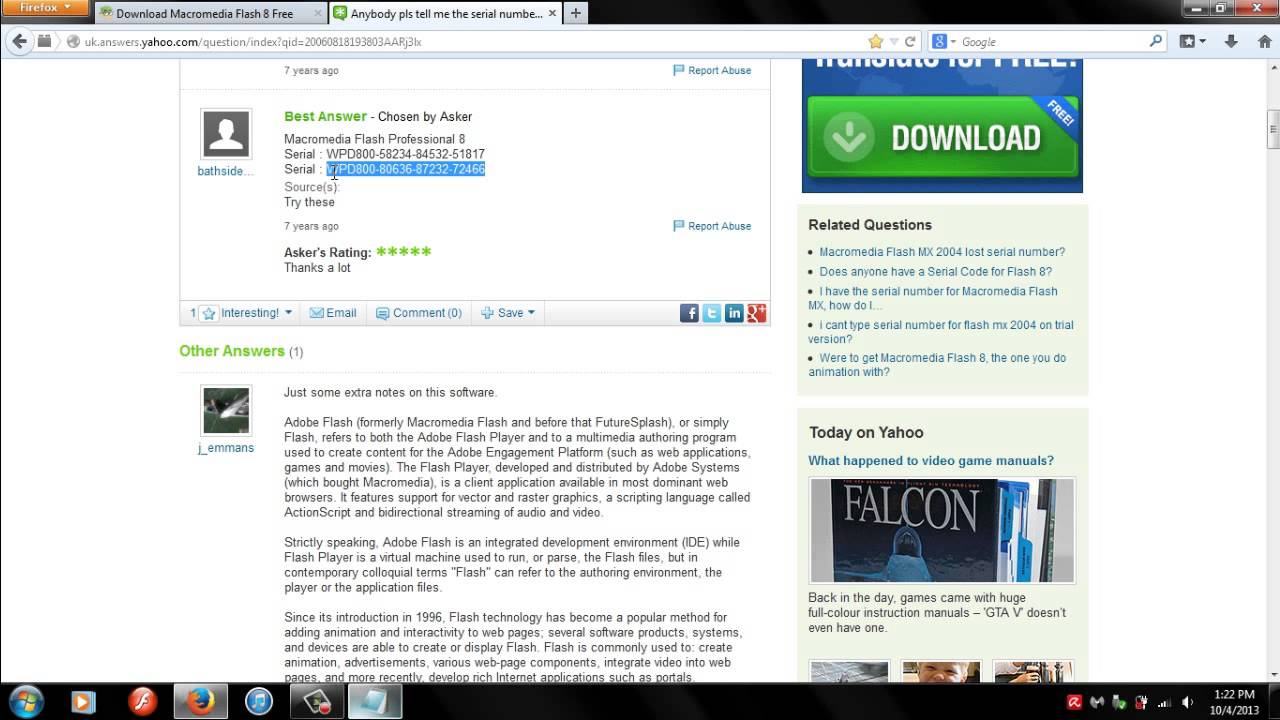
- Adobe Macromedia Flash 8
- Download Keygen Macromedia Flash 8 Free Download
Download Macromedia Flash 8 dan Keygen Em Aqi Je 02:38:00 pm Download Software. Kalian butuh software untuk membuat game flash, aplikasi flash, animasi gambar, aplikasi web, atau gambar vekttor, pasti sebagian orang dari para visitor blog ini sudah mengetahuinnya, yah software tersebut adalah Macromedia Flash 8. Macromedia Flash Professional 8 Full Keygen. Macromedia Flash 8 is a software that can be relied upon and greatly assist you in making an animation with great ease. This software is designed and specials to make 2D animation is well suited to assist you in making animated banner or just to beautify your website. Nov 08, 2017 Macromedia Flash 8 free download from here just with a single click. For this, we provide a direct link to download. Through this app, you can develop awesome power flash with the help of Macromedia Flash 8. MACROMEDIA FLASH 8 Overview Get this amazing tools for your windows on the desktop and enable yourself to.
GET the Current Macromedia Display Professional 8 Split 2017 Free of charge Full Edition with Keygen Service and ULTIMATE Serial Essential UPDATED Full Crack Serial Keygen A Place Macromedia Flash Participant 8 Expert incl Split Full Edition. Macromedia Display Participant 8 Professional Crack will be the most current Macromedia Display Expert 8 Total Keygen. Macromedia Flash 8 is a software program that can be depended upon and greatly help you in making an computer animation with excellent simplicity.
Macromedia Display 8 free download. Get the latest version today. Macromedia's professional web design Web Download Manager IDM For Free of charge + Serial Key Crack Full Edition 2018 - Length: 7:23. Razdar Ali Online Ideas 126,635 views Download Macromedia Flash 8 + Keygen Full Edition, D-K CráckBuzz, Download Macromedia Adobe flash 8 + Keygen Full Edition Macromedia Display Pro 8 Total version.gua download waktu extract gabisa eror paswórdnya yg bener ápasi eror mulu mending kuyhaa yg dulu pasword tinggal copas ini Top Full Games And Software program Macromedia Flash 8! File Dimension:MB. Internet Download Manager IDM Build 17 Full Split; Macromedia Adobe flash 8 crack Toggle Remark Threads Keyboard Cutting corners. Macromedia Display 8 Total License Key is Here!
Macromedia flash 8 free download full version crack, Macromedia Flash Player 10.0.45.2, GetGo Download Manager 4.7.3.1085, Code Crack HD 1.1.
Install Macromedia Adobe flash version 8; Macromedia Display 8 break Toggle Remark Threads Macromedia Adobe flash 8 Full License Essential is Right here! Macromedia Adobe flash 8. Install Macromedia Flash version 8; Macromedia Adobe flash 8 adalah sebuah system standar untuk pembuatan animasi High Download software full edition gratis. Free Download Macromedia Adobe flash 8 + Break. Driven by considerable global consumer input Macromedia Display 8 Macromedia Flash 8 Free of charge Safe Download! Macromedia Adobe flash 8 Most recent Version! Your full address Macromedia Flash Expert 8 Total Keygen.Macromedia Adobe flash 8 is usually a software Macromedia Adobe flash Professional 8 Total, Ant Download Supervisor Pro Total Crack; Content about Free Download Macromedia Adobe flash 8 + Split created by yaggie09.
Yaggie hasley. Download software full version gratis. Pengenalan interface Macromedia Macromedia Display Participant 8 Expert Crack will be Macromedia Display Player 8 Expert incl Split Full Version. You can quickly download this fIash Macromedia flash 8 free of charge download complete version split, Macromedia Display Player 5.2, GetGo Download Manager. 1085, Code Break HD 1.1.
Adobe Macromedia Flash 8
Powered by comprehensive, global customer input, Macromedia Adobe flash 8 Professional scars a substantial discharge that encompasses major advancements in expressive tools, video clip, quality user encounters, and mobile content material authoring.The brand-new custom reducing tool allows precise control over animation. The groundbreaking FlashType font-rendering motor ensures clear, high-quality text message. These fresh expressive functions raise the pub for the quality of company and specific websites and improve digital encounters.
Download Keygen Macromedia Flash 8 Free Download
Found 5377 outcomes for: Macromedia Display 8 Expert Keygen. Berikut serial number macromedia flash 8 wpd800-2-63979 wpd800-2-32479 wpd800-2-74845 wpd800-2-12149 wpd800-50832-672 Slideshare uses biscuits to improve functionality and efficiency, and to provide you with appropriate advertising.Watch in text. Similar activation keys. Macromedia Display Expert 8Found: 22 February 2019 Rating: 95/100Download right now the serial amount for Macromedia Display Expert 8.
All serial numbers are real and you can discover more results in our database for Macromedia software. Updates are issued periodically and brand-new results might become added for this programs from our area.Found: 13 Jan 2019 Ranking: 83/100Driven by comprehensive, global consumer input, Macromedia Flash 8 Expert scars a significant launch that encompasses major developments in significant tools, movie, quality user encounters, and mobile content authoring.
Macromedia Adobe flash Professional 8 is usually one of the personal computer software used to create vector images and animated images. Files produced by this software provides a file expansion. Swf and can end up being performed in a web internet browser that offers been fitted with Adobe Flash Player. Display uses a programming language known as ActionScript which very first made an appearance in Adobe flash 5. Before 2005, released by Macromedia Display. Display 1.0 has been released in 1996 after purchasing Macromedia vector animation program known as FutureSplash.
The final edition, which has been launched on the market under the title of 'Macromedia' is certainly Macromedia Adobe flash 8. On December 3, 2005 Adobe Techniques acquired Macromedia and its items, so the name transformed to Adobe Adobe flash Macromedia Flash.
Macromedia Flash 8 provides designers a platform to produce cartoons, video clips, and games that make Web websites dancing and sing, and it will therefore with simplicity. This Display upgrade facilitates an development in the animated Web expertise, ánd it's á must-have fór serious site designers. Flash authors should heated to the numerous work-flow ánd design-tool enhancements, including new runtime blend modes, filters and results, assistance for alpha-channel video, and a rebuilt movie codec to reduce file size and playback time.
Enthusiasts seeking to put Flash content material on their private Web web pages should choose for Display Basic, although it lacks the even more alluring brand-new features provided by the even more expensive Adobe flash Professional 8. You can furthermore buy Flash Professional 8 packaged with the Macromedia Studio 8 collection for about a thousand dollars or upgrade for less from a previous version of Facility.
Macromedia / Adobe Flash officially dies 31 December 2020 – after 25 years
The original 1995 ShockWave Global Download Servers at Macromedia HQ San Francisco
Back in 1995 Macromedia’s influence on interactive media began with the launch of Shockwave, a technology that converted Macromedia Director presentations into a compressed format for web delivery: the first true animations on the Internet, which also allowed Youtube to exist later, delivering video streams in a highly conpressed – and thus affordable – format.
I can claim I helped Shockwave to be a success, as I built the delivery infrastructure for it, which had been neglected during the programming and planning phase, and having it ready ‘just in time’ for the highly hyped launch date. Due to the overwhelming success of Shockwave, Macromedia acquired a small company in San Diego (“FutureFlash Inc”) with only one customer (Microsoft) for $30m.
The merger of their Flash product and Shockwave became what pretty much every web user had installed for the last 25 years: the Flash Player.
See the history here on Wikipedia, and the story with pictures here on my website.

Now, 25 years later, and riddled with an abundance of security issues, this chapter comes to an end:
Adobe Flash Player EOL General Information Page
- When is the Flash Player end-of-life (EOL)?
As previously announced in July 2017, Adobe will stop distributing and updating Flash Player after December 31, 2020 (“EOL Date”). We made this announcement in collaboration with several of our technology partners – including Apple, Facebook, Google, Microsoft and Mozilla – which issued complementary announcements with more technical detail on what the Flash Player EOL will mean for developers, enterprises, and consumers using their specific OS environments or browsers. - Why did Adobe decide to EOL Flash Player and select the end of 2020 date?
Open standards such as HTML5, WebGL, and WebAssembly have continually matured over the years and serve as viable alternatives for Flash content. Also, the major browser vendors are integrating these open standards into their browsers and deprecating most other plug-ins (like Adobe Flash Player).By announcing our business decision in 2017, with three years’ advance notice, we believed that would allow sufficient time for developers, designers, businesses, and other parties to migrate existing Flash content as needed to new, open standards - How will this decision impact Adobe Flash Player support and distribution for the remainder of the year (2020)?
Adobe will continue issuing regular Flash Player security patches, maintain OS and browser compatibility, and add features and capabilities as determined by Adobe through the end of 2020. - Will Adobe make previous versions of Adobe Flash Player available for download after 2020?
No. Adobe will be removing Flash Player download pages from its site and Flash-based content will be blocked from running in Adobe Flash Player after the EOL Date.
Adobe always recommends using the latest, supported and up-to-date software. Customers should not use Flash Player after the EOL Date since it will not be supported by Adobe. - If I find Flash Player available for download on a third-party website, can I use it?
No, these versions of Flash Player are not authorized by Adobe. Customers should not use unauthorized versions of Flash Player. Unauthorized downloads are a common source of malware and viruses. Adobe has no responsibility for unauthorized versions of Flash Player and customers’ use of such versions is entirely at their own risk. - Which browsers and operating systems currently support Adobe Flash Player?
Please visit http://www.adobe.com/products/flashplayer/tech-specs.html for the latest list of Flash-supported browsers and operating systems. Note, as it gets closer to the EOL Date, the number of Flash-supported browsers and operating systems may decrease so Adobe strongly encourages customers to migrate to other standards. - Will Adobe provide security updates for Flash Player after the end-of-life date?
Adobe will not issue Flash Player updates or security patches after the EOL Date. We recommend that all users uninstall Flash Player before the EOL date (see manual uninstall instructions for Windows and Mac users). Users will be prompted by Adobe to uninstall Flash Player on their machines later this year and Flash-based content will be blocked from running in Adobe Flash Player after the EOL Date.
from: https://www.adobe.com/products/flashplayer/end-of-life.html#
Der Flash Player stirbt endlich offiziell
Der Hersteller Adobe hat erstmals ein konkretes Datum genannt, an dem der Flash Player eingestellt wird.
Das Web-Plugin Flash schien einfach nicht verschwinden zu wollen. Seit Jahren beschweren sich User und Entwickler gleichermaßen über den veralteten Standard. Wenn man noch darüber sprach, dann nur, weil schon wieder eine neue Sicherheitslücke dafür aufgetaucht ist.
Die schlechte Performance von Flash und ständigen Sicherheitslücken wurden auch den Browseranbietern zu viel. Mittlerweile ist bei allen großen Browsern Flash standardmäßig deaktiviert.
Schluss, aus, finito!
Jetzt hat wohl auch Adobe eingesehen, dass es keinen Sinn mehr hat, Flash weiter am Leben zu erhalten. Auf der offiziellen Support-Seite ist zu lesen, dass der Flash Player am 31. Dezember 2020 eingestellt wird. Adobe wird ihn nicht mehr zum Download anbieten und bisherige Versionen werden nicht mehr aktualisiert.
Adobe will auch keine kritischen Sicherheitsupdates nach diesem Stichtag zur Verfügung stellen. Adobe empfiehlt Usern den Flash Player bis zum 31. Dezember 2020 zu deinstallieren. Ende des Jahres werden User per Systemnachricht aufgefordert, den Flash Player zu deinstallieren. Wird das nicht gemacht, wird der Flash Player unbrauchbar: Nach dem 31. Dezember 2020 können damit keine Flash-Inhalte mehr wiedergegeben werden.
Apple und YouTube als Flash-Killer
Flash war Anfang der 2000er weit auf Websites verbreitet. Besonders bei interaktiven Elementen, Games und zur Wiedergabe von Videos und Audio kam es zum Einsatz. Bei der Gründung von YouTube nutzte das Videoportal ebenfalls Flash.
Das Ende wurde 2007 eingeleitet. Apples iPhone unterstützte kein Flash. YouTube begann deshalb die Videos in HTML5 anzubieten, damit das Portal von iPhone-Usern genutzt werden konnte. 2010 verfasste schließlich Steve Jobs einen offenen Brief, in dem er Flash kritisierte und bekannt gab, dass Flash auf iOS-Geräten nicht erlaubt ist.
2015 stellte YouTube komplett auf HTML5 um. Schon damals ging man davon aus, dass dies der letzte Sargnagel für Flash sei. Adobe kündigte aber erst 2017 an, Flash einstellen zu wollen – ohne konkretes Datum. 3 Jahre später wird dieses Kapitel Web-Geschichte nun endgültig geschlossen.
from: https://futurezone.at/produkte/der-flash-player-stirbt-endlich-offiziell/400945928
P.S.: the original 1995 Macromedia Shockwave download server racks ended up in a Dallas transmission shop (picture from 2012 – they are probably still there), after being thrown out in 1998, and serving in my living room to host my stereo equipment:

2305 Southwell Road in Dallas – if you want to lay your hands on a piece of history.
What’s New in the macromedia flash 8 [25 May 2017] serial key or number?
Screen Shot

System Requirements for Macromedia flash 8 [25 May 2017] serial key or number
- First, download the Macromedia flash 8 [25 May 2017] serial key or number
-
You can download its setup from given links:

macromedia flash 8 [25 May 2017] serial key or number & Serial Key Download

macromedia flash 8 [25 May 2017] serial key or number& Serial Key Download

macromedia flash 8 [25 May 2017] serial key or number
About Author
