
Code Visual to FlowChart 5.x serial key or number
Code Visual to FlowChart 5.x serial key or number
How to Draw Sequence Diagram?
A sequence diagram is a kind of UML diagram that is used primarily to show the interactions between objects that are represented as lifelines in a sequential order.
Creating sequence diagram
Perform the steps below to create a UML sequence diagram Visual Paradigm uml diagram tools.
- Select Diagram > New from the application toolbar.
- In the New Diagram window, select Sequence Diagram.
- Click Next.
- Enter the diagram name and description. The Location field enables you to select a model to store the diagram.
- Click OK.
Creating actor
To create actor, click Actor on the diagram toolbar and then click on the diagram.
 |
| Create actor |
Creating lifeline
To create lifeline, you can click LifeLine on the diagram toolbar and then click on the diagram.
Alternatively, a much quicker and more efficient way is to use Resource Catalog:
- Move your mouse pointer over the source lifeline.
- Press on the Resource Catalog button and drag it out.
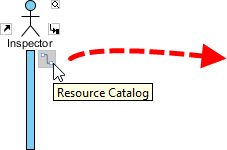
Using Resource Catalog - Release the mouse button at the place where you want the lifeline to be created.
- Select Message -> LifeLine from Resource Catalog.
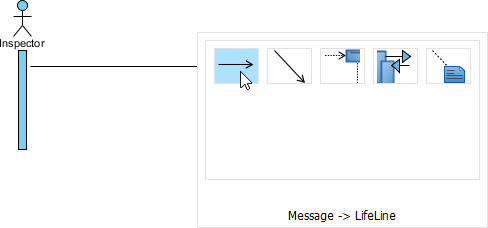
To create a lifeline - A new lifeline will be created and connected to the actor/lifeline with a message. Enter its name and press Enter to confirm editing.
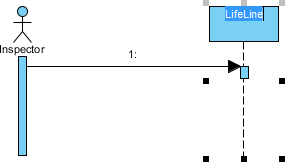
Lifeline created
Auto extending activation
When create message between lifelines/actors, activation will be automatically extended.
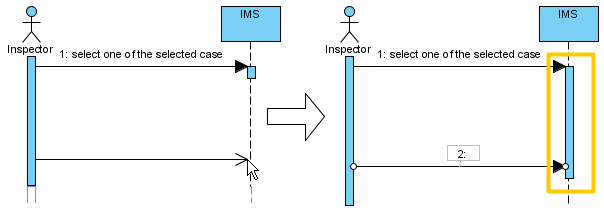 |
| Auto extending activation |
Using sweeper and magnet to manage sequence diagram
Sweeper helps you to move shapes aside to make room for new shapes or connectors. To use sweeper, click the Selector on the toolbar, then select Sweeper.
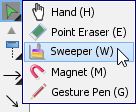 |
| sweeper |
Click on empty space of the diagram and drag towards top, right, bottom or left. Shapes affected will be swept to the direction you dragged.
The picture below shows the actorInspector Assistant is being swept towards right, thus new room is made for new lifelines.
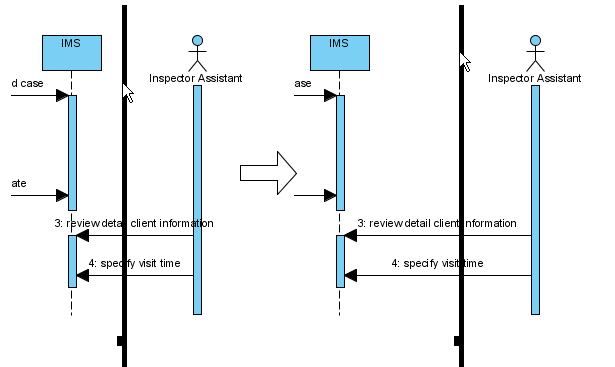 |
| Sweep towards right |
The picture below shows the message specify visit time is being swept downwards, thus new room is made for new messages.
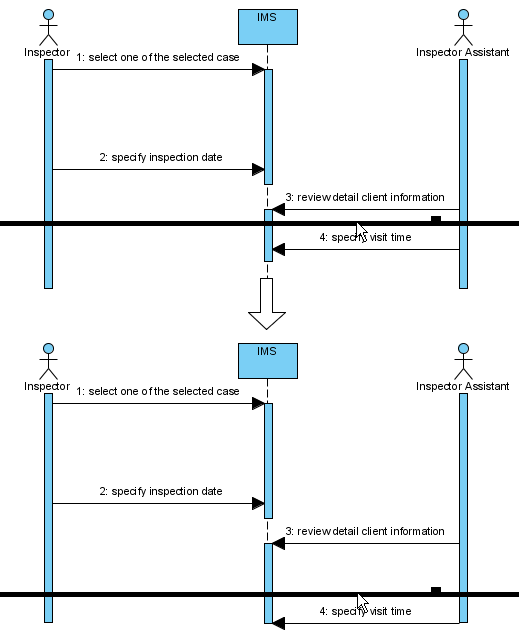 |
| Sweep downwards |
You can also use magnet to pull shapes together. To use magnet, click the Selector on the toolbar, then select Magnet.
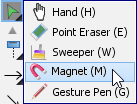 |
| Magnet |
Click on empty space of the diagram and drag towards top, right, bottom or left. Shapes affected will be pulled to the direction you dragged.
The picture below shows when drag the magnet upwards, shapes below dragged position are pulled upwards.
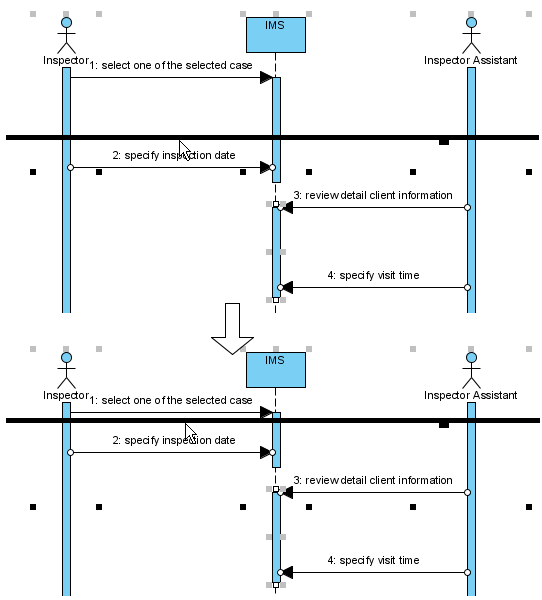 |
| Pull shapes upwards using magnet |
Creating combined fragment for messages
To create combined fragment to cover messages, select the messages, right-click on the selection and select Create Combined Fragment and then select a combined fragment type (e.g. loop) from the popup menu.
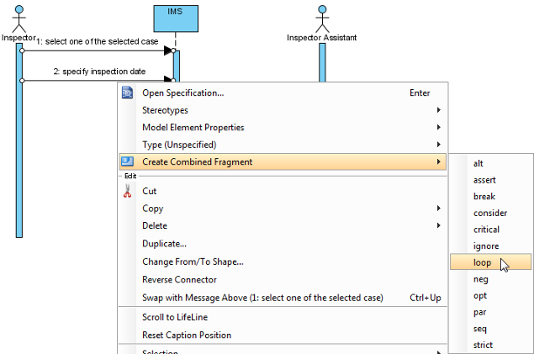 |
| Create combined fragment for messages |
A combined fragment of selected type will be created to cover the messages.
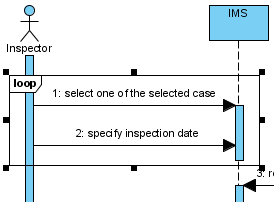 |
| Combined fragment created |
Adding/removing covered lifelines
After you've created a combined fragment on the messages, you can add or remove the covered lifelines.
- Move the mouse over the combined fragment and select Add/Remove Covered Lifeline... from the pop-up menu.
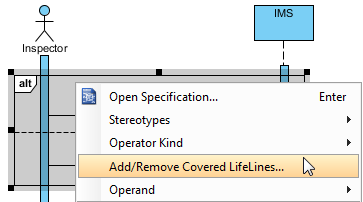
Add/Remove covered lifelines - In the Add/Remove Covered Lifelines window, check the lifeline(s) you want to cover or uncheck the lifeline(s) you don't want to cover. Click OK button.
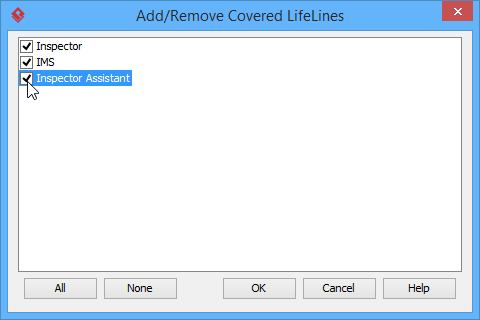
Check Inspector Assistant
As a result, the area of covered lifelines is extended or narrowed down according to your selection.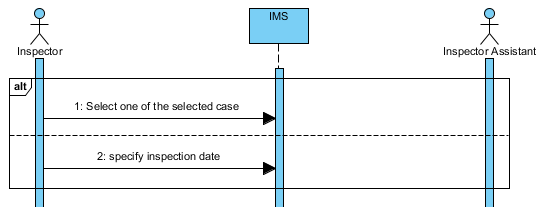
The area of covered lifelines is extended
Managing Operands
After you've created a combined fragment on the messages, you can also add or remove operand(s).
- Move the mouse over the combined fragment and select Operand > Manage Operands... from the pop-up menu.
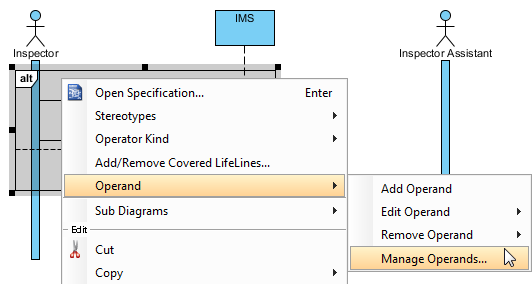
Manage operands - To remove an operand, select the target operand from Operands and click Remove button. Click OK button.
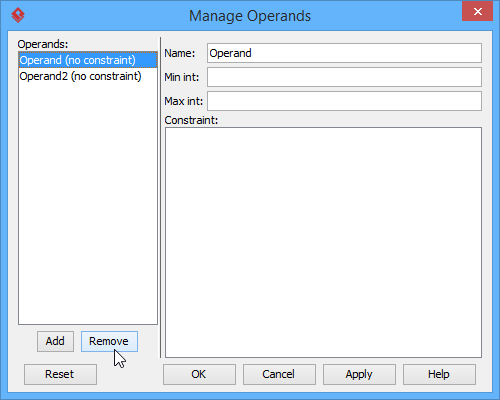
Remove Operand
Otherwise, click Add button to add a new operand and then name it. Click OK button.
Developing sequence diagram with quick editor or keyboard shortcuts
In sequence diagram, an editor appears at the bottom of diagram by default, which enables you to construct sequence diagram with the buttons there. The shortcut keys assigned to the buttons provide a way to construct diagram through keyboard. Besides constructing diagram, you can also access diagram elements listing in the editor.
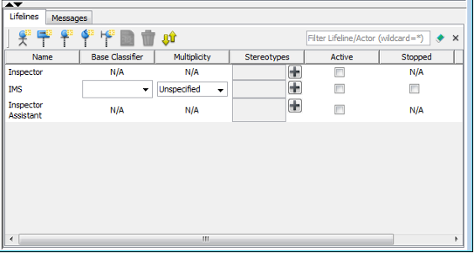 |
| The quick editor |
Editing lifelines
There are two panes, Lifelines and Messages. The Lifelines pane enables you to create different kinds of actors and lifelines.
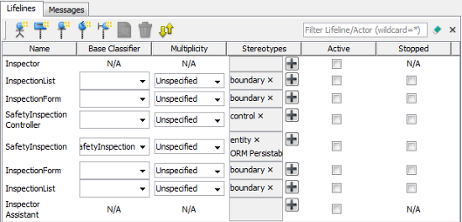 |
| Lifelines pane in quick editor |
Editing messages
The Messages pane enables you to connect lifelines with various kinds of messages.
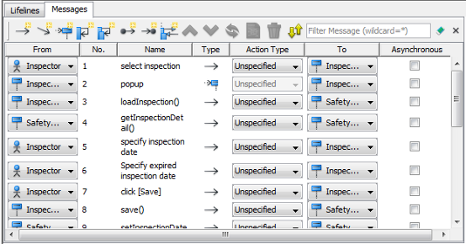 |
| Messages pane in quick editor |
Expanding and collapsing the editor
To hide the editor, click on the down arrow button that appears at the bar on top of the quick editor. To expand, click on the up arrow button.
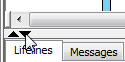 |
| Collapse the quick editor |
Setting different ways of numbering sequence messages
You are able to set the way of numbering sequence messages either on diagram base or frame base.
Diagram-based sequence message
Right click on the diagram's background, select Sequence Number and then either Single Level or Nested Level from the pop-up menu.
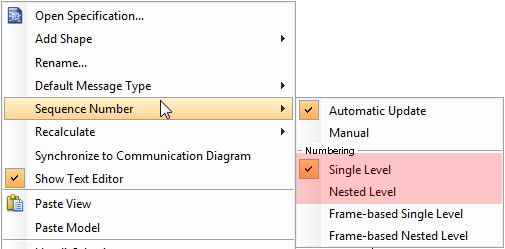 |
| Diagram-based pop-up menu |
If you choose Single Level, all sequence messages will be ordered with integers on diagram base. On the other hand, if you choose Nested Level, all sequence messages will be ordered with decimal place on diagram base.
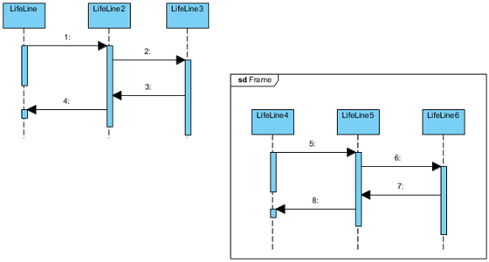 |
| Single level |
Frame-based sequence message
Right click on the diagram's background, select Sequence Number and then either Frame-based Single Level or Frame-based Nested Level from the pop-up menu.
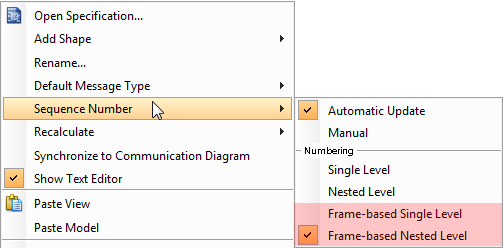 |
| Frame-based pop-up menu |
When you set the way of numbering sequence messages on frame base, the sequence messages in frame will restart numbering sequence message since they are independent and ignore the way of numbering sequence message outside the frame.
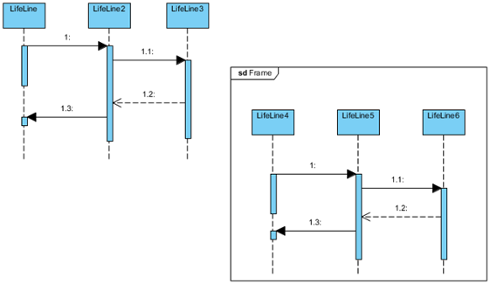 |
| Frame-based nested level |
Related Resources
The following resources may help you to learn more about the topic discussed in this page.
C programming Tutorial
Getting Started - Write your First Hello-world C Program
Let's begin by writing our first C program that prints the message "Hello, world!" on the display console:
Hello, world!Step 1: Write the Source Code: Enter the following source codes using a programming text editor (such as NotePad++ for Windows or gEdit for UNIX/Linux/Mac) or an Interactive Development Environment (IDE) (such as CodeBlocks, Eclipse, NetBeans or MS Visual Studio - Read the respective "How-To" article on how to install and get started with these IDEs).
Do not enter the line numbers (on the left panel), which were added to help in the explanation. Save the source file as "". A C source file should be saved with a file extension of "". You should choose a filename which reflects the purpose of the program.
| 1 2 3 4 5 6 7 8 9 | /* * First C program that says Hello (Hello.c) */ #include <stdio.h> // Needed to perform IO operations int main() { // Program entry point printf("Hello, world!\n"); // Says Hello return 0; // Terminate main() } // End of main() |
Step 2: Build the Executable Code: Compile and Link (aka Build) the source code "" into executable code ("" in Windows or "" in UNIX/Linux/Mac).
- On IDE (such as CodeBlocks), push the "Build" button.
- On Text editor with the GNU GCC compiler, start a CMD Shell (Windows) or Terminal (Mac, Linux) and issue these commands: // Windows (CMD shell) - Build "Hello.c" into "Hello.exe" > gcc -o Hello.exe Hello.c // UNIX/Linux/Mac (Bash shell) - Build "Hello.c" into "Hello" $ gcc -o Hello Hello.c where is the name of GCC C compiler; option specifies the output filename ("" for Windows or "" for UNIX/Linux/Mac); "" is the input source file.
Step 3: Run the Executable Code: Execute (Run) the program.
- On IDE (such as CodeBlocks), push the "Run" button.
- On Text Editor with GNU GCC compiler, issue these command from CMD Shell (Windows) or Terminal (UNIX/Linux/Mac): // Windows (CMD shell) - Run "Hello.exe" (.exe is optional) > Hello Hello, world! // UNIX/Linux/Mac (Bash shell) - Run "Hello" (./ denotes the current directory) $ ./Hello Hello, world!
Brief Explanation of the Program
/* ...... */
// ... until the end of the line
These are called comments. Comments are NOT executable and are ignored by the compiler. But they provide useful explanation and documentation to your readers (and to yourself three days later). There are two kinds of comments:
- Multi-line Comment: begins with and ends with . It may span more than one lines (as in Lines 1-3).
- End-of-line Comment: begins with and lasts until the end of the current line (as in Lines 4, 6, 7, 8, and 9).
#include <stdio.h>
The "" is called a preprocessor directive. A preprocessor directive begins with a sign, and is processed before compilation. The directive "" tells the preprocessor to include the "" header file to support input/output operations. This line shall be present in all our programs. I will explain its meaning later.
int main() { ...... }
defines the so-called function. The function is the entry point of program execution. is required to return an (integer).
printf("Hello, world!\n");
We invoke the function to print the string "Hello, world!" followed by a newline () to the console. The newline () brings the cursor to the beginning of the next line.
return 0;
terminates the function and returns a value of 0 to the operating system. Typically, return value of 0 signals normal termination; whereas value of non-zero (usually 1) signals abnormal termination. This line is optional. C compiler will implicitly insert a "" to the end of the function.
C Terminology and Syntax
Statement: A programming statement performs a piece of programming action. It must be terminated by a semi-colon () (just like an English sentence is ended with a period) as in Lines 7 and 8.
Preprocessor Directive: The (Line 4) is a preprocessor directive and NOT a programming statement. A preprocessor directive begins with hash sign (). It is processed before compiling the program. A preprocessor directive is NOT terminated by a semicolon - Take note of this rule.
Block: A block is a group of programming statements enclosed by braces . This group of statements is treated as one single unit. There is one block in this program, which contains the body of the function. There is no need to put a semi-colon after the closing brace.
Comments: A multi-line comment begins with and ends with . An end-of-line comment begins with and lasts till the end of the line. Comments are NOT executable statements and are ignored by the compiler. But they provide useful explanation and documentation. Use comments liberally.
Whitespaces: Blank, tab, and newline are collectively called whitespaces. Extra whitespaces are ignored, i.e., only one whitespace is needed to separate the tokens. But they could help you and your readers better understand your program. Use extra whitespaces liberally.
Case Sensitivity: C is case sensitive - a ROSE is NOT a Rose, and is NOT a rose.
The Process of Writing a C Program
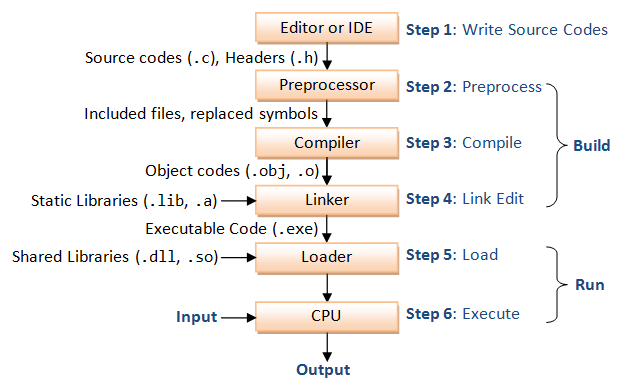
Step 1: Write the source codes () and header files ().
Step 2: Pre-process the source codes according to the preprocessor directives. The preprocessor directives begin with a hash sign (), such as and . They indicate that certain manipulations (such as including another file or replacement of symbols) are to be performed BEFORE compilation.
Step 3: Compile the pre-processed source codes into object codes (, ).
Step 4: Link the compiled object codes with other object codes and the library object codes (, )to produce the executable code ().
Step 5: Load the executable code into computer memory.
Step 6: Run the executable code.
C Program Template
You can use the following template to write your C programs. Choose a meaningful filename for you source file that reflects the purpose of your program with file extension of "". Write your programming statements inside the body of the function. Don't worry about the other terms for the time being. I will explain them later.
| 1 2 3 4 5 6 7 8 9 10 | /* * Comment to state the purpose of this program (filename.c) */ #include <stdio.h> int main() { // Your Programming statements HERE! return 0; } |
Let's Write a Program to Add a Few Numbers
Example: Adding Two Integers
Let's write a C program called "" to add two integers as follows:
Add2Integers.c
| 1 2 3 4 5 6 7 8 9 10 11 12 13 14 15 16 17 18 19 | /* * Add two integers and print their sum (Add2Integers.c) */ #include <stdio.h> int main() { int integer1; // Declare a variable named integer1 of the type integer int integer2; // Declare a variable named integer2 of the type integer int sum; // Declare a variable named sum of the type integer integer1 = 55; // Assign value to variable integer1 integer2 = 66; // Assign value to variable integer1 sum = integer1 + integer2; // Compute the sum // Print the result printf("The sum of %d and %d is %d.\n", integer1, integer2, sum); return 0; } |
Dissecting the Program
int integer1;
int integer2;
int sum;
We first declare three (integer) variables: , , and . A variable is a named storage location that can store a value of a particular data type, in this case, (integer). You can declare one variable in one statement. You could also declare many variables in one statement, separating with commas, e.g.,
integer1 = 55;
integer2 = 66;
sum = integer1 + integer2;
We assign values to variables and ; compute their sum and store in variable .
printf("The sum of %d and %d is %d.\n", integer1, integer2, sum);
We use the function to print the result. The first argument in is known as the formatting string, which consists of normal texts and so-called conversion specifiers. Normal texts will be printed as they are. A conversion specifier begins with a percent sign (), followed by a code to indicate the data type, such as for decimal integer. You can treat the as placeholders, which will be replaced by the value of variables given after the formatting string in sequential order. That is, the first will be replaced by the value of , second by , and third by . The denotes a newline character. Printing a bring the cursor to the beginning of the next line.
Example: Prompting User for Inputs
In the previous example, we assigned fixed values into variables and . Instead of using fixed values, we shall prompt the user to enter two integers.
PromptAdd2Integers.c
| 1 2 3 4 5 6 7 8 9 10 11 12 13 14 15 16 17 18 19 20 | /* * Prompt user for two integers and print their sum (PromptAdd2Integers.c) */ #include <stdio.h> int main() { int integer1, integer2, sum; // Declare 3 integer variablesprintf("Enter first integer: "); // Display a prompting messagescanf("%d", &integer1); // Read input from keyboard into integer1printf("Enter second integer: "); // Display a prompting messagescanf("%d", &integer2); // Read input into integer2 sum = integer1 + integer2; // Compute the sum // Print the result printf("The sum of %d and %d is %d.\n", integer1, integer2, sum); return 0; } |
Disecting the Program
int integer1, integer2, sum;
We first declare three (integer) variables: , , and in one statement.
printf("Enter first integer: ");
We use the function to put out a prompting message.
scanf("%d", &integer1);
We then use the function to read the user input from the keyboard and store the value into variable .The first argument of is the formatting string (similar to ).The conversion specifier provides a placeholder for an integer, which will be substituted by variable . Take note that we have to place an ampersand sign (), which stands for address-of operator, before the variable, I shall explain its significance later. It is important to stress that missing ampersand () in is a common error, which leads to abnormal termination of the program.
Reading Multiple Integers
You can read multiple items in one statement as follows:
printf("Enter two integers: "); // Display a prompting message scanf("%d%d", &integer1, &integer2); // Read two integersIn the , the first puts the first integer entered into variable , and the second puts into . Again, remember to place an ampersand () before the variables in .
Exercises
- Print each of the following patterns. Use one statement for each line of outputs. End each line by printing a newline (). * * * * * * * * * * * * * * * * * * * * * * * * * * * * * * * * * * * * * * * * * * * * * * * * * * * * * (a) (b) (c)
- Print the above patterns using ONE statement.
- Write a program to prompt user for 5 integers and print their sum. Use five variables to to store the five integers.
- Write a program to prompt user for 5 integers and print their product. Use an variable to store the product and operator for multiplication.
What is a Program?
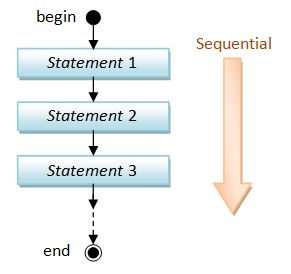
A program is a sequence of instructions (called programming statements), executing one after another - usually in a sequential manner, as illustrated in the previous example and the following flow chart.
Example (Sequential): The following program () prompts user for the radius of a circle, and prints its area and circumference. Take note that the programming statements are executed sequentially - one after another in the order that they are written.
| 1 2 3 4 5 6 7 8 9 10 11 12 13 14 15 16 17 18 19 20 21 22 23 24 | /* * Prompt user for the radius of a circle and compute its area and circumference * (CircleComputation.c) */ #include <stdio.h> int main() { double radius, circumference, area; // Declare 3 floating-point variables double pi = 3.14159265; // Declare and define PI printf("Enter the radius: "); // Prompting message scanf("%lf", &radius); // Read input into variable radius // Compute area and circumference area = radius * radius * pi; circumference = 2.0 * radius * pi; // Print the results printf("The radius is %lf.\n", radius); printf("The area is %lf.\n", area); printf("The circumference is %lf.\n", circumference); return 0; } |
Dissecting the Program
double radius, circumference, area;
double pi = 3.14159265;
We declare three variables called , and . A variable, unlike , can hold real number (or floating-point number) such as 1.23 or 4.5e6. We also declare a variable called and initialize its value to 3.1416.
printf("Enter the radius: ");
scanf("%lf", &radius);
We use to put up a prompt message, and to read the user input into variable . Take note that the conversion specifier for ( stands for long float). Also remember to place an ampersand () before .
area = radius * radius * pi;
circumference = 2.0 * radius * pi;
perform the computation.
printf("The radius is %lf.\n", radius);
printf("The area is %lf.\n", area);
printf("The circumference is %lf.\n", circumference);
Again, we use conversion specifier to print a .
Take note that the programming statements inside the are executed one after another, sequentially.
Exercises
- Follow the above example, write a program to print the area and perimeter of a rectangle. Your program shall prompt the user for the length and width of the rectangle, in s.
- Follow the above example, write a program to print the surface area and volume of a cylinder. Your program shall prompt the user for the radius and height of the cylinder, in s.
What is a Variable?
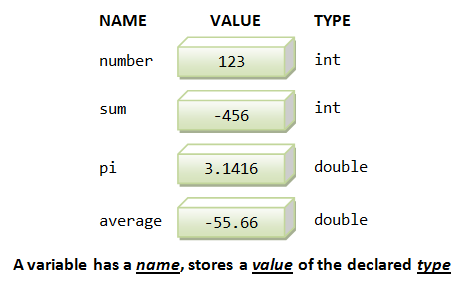
Computer programs manipulate (or process) data. A variable is used to store a piece of data for processing. It is called variable because you can change the value stored.
More precisely, a variable is a named storage location, that stores a value of a particular data type. In other words, a variable has a name, a type and stores a value of that type.
- A variable has a name (or identifier), e.g., , , , . The name is needed to uniquely identify and reference a variable, so as to assign a value to the variable (e.g., ), and retrieve the value stored (e.g., ).
- A variable has a type. Examples of type are:
- : for integers (whole numbers) such as and ;
- : for floating-point or real numbers, such as , , , , having a decimal point and fractional part, in fixed or scientific notations.
- A variable can store a value of the declared type. It is important to take note that a variable is associated with a type, and can only store value of that particular type. For example, a variable can store an integer value such as , but NOT real number such as , nor texts such as . The concept of type was introduced into the early programming languages to simplify interpretation of data.
The above diagram illustrates 2 types of variables: and . An variable stores an integer (whole number). A variable stores a real number.
To use a variable, you need to first declare its name and type, in one of the following syntaxes:
var-typevar-name; // Declare a variable of a typevar-typevar-name-1, var-name-2,...; // Declare multiple variables of the same typevar-typevar-name = initial-value; // Declare a variable of a type, and assign an initial valuevar-typevar-name-1 = initial-value-1, var-name-2 = initial-value-2,... ; // Declare variables with initial valuesTake note that:
- Each declaration statement is terminated with a semi-colon ().
- In multiple-variable declaration, the names are separated by commas ().
- The symbol , known as the assignment operator, can be used to assign an initial value (of the declared type) to the variable.
For example,
int sum; // Declare a variable named "sum" of the type "int" for storing an integer. // Terminate the statement with a semi-colon. int number1, number2; // Declare two "int" variables named "number1" and "number2", // separated by a comma. double average; // Declare a variable named "average" of the type "double" for storing a real number. int height = 20; // Declare an int variable, and assign an initial value.Once a variable is declared, you can assign and re-assign a value to a variable, via the assignment operator "". For example,
int number; // Declare a variable named "number" of the type "int" (integer) number = 99; // Assign an integer value of 99 to the variable "number" number = 88; // Re-assign a value of 88 to "number" number = number + 1; // Evaluate "number + 1", and assign the result back to "number" int sum = 0; // Declare an int variable named sum and assign an initial value of 0 sum = sum + number; // Evaluate "sum + number", and assign the result back to "sum", i.e. add number into sum int num1 = 5, num2 = 6; // Declare and initialize two int variables in one statement, separated by a comma double radius = 1.5; // Declare a variable name radius, and initialize to 1.5int number;// ERROR: A variable named "number" has already been declaredsum = 55.66;// WARNING: The variable "sum" is an int. It shall not be assigned a floating-point numbersum = "Hello";// ERROR: The variable "sum" is an int. It cannot be assigned a text stringTake note that:
- Each variable can only be declared once.
- You can declare a variable anywhere inside the program, as long as it is declared before it is being used.
- Once the type of a variable is declared, it can only store a value belonging to this particular type. For example, an variable can hold only integer such as , and NOT floating-point number such as or text string such as .
- The type of a variable cannot be changed inside the program.
x=x+1?
Assignment () in programming is different from equality in Mathematics. e.g., "" is invalid in Mathematics. However, in programming, it means compute the value of plus 1, and assign the result back to variable .
"x+y=1" is valid in Mathematics, but is invalid in programming. In programming, the RHS of "" has to be evaluated to a value; while the LHS shall be a variable. That is, evaluate the RHS first, then assign to LHS.
Some languages uses as the assignment operator to avoid confusion with equality.
Basic Arithmetic Operations
The basic arithmetic operators are:
| Operator | Meaning | Example |
|---|---|---|
| Addition | ||
| Subtraction | ||
| Multiplication | ||
| Division | ||
| Modulus (Remainder) | ||
| Increment by 1 (Unary) | or | |
| Decrement by 1 (Unary) | or |
Addition, subtraction, multiplication, division and remainder are binary operators that take two operands (e.g., ); while negation (e.g., ), increment and decrement (e.g., , ) are unary operators that take only one operand.
Example
The following program () illustrates these arithmetic operations.
| 1 2 3 4 5 6 7 8 9 10 11 12 13 14 15 16 17 18 19 20 21 22 23 24 25 26 27 28 29 30 31 32 33 34 35 36 37 | /* * Test arithmetic operations (TestArithmetics.c) */ #include <stdio.h> int main() { int number1, number2; // Declare 2 integer variable number1 and number2 int sum, difference, product, quotient, remainder; // declare 5 int variables // Prompt user for the two numbers printf("Enter two integers (separated by space): "); scanf("%d%d", &number1, &number2); // Use 2 %d to read 2 integers // Do arithmetic Operations sum = number1 + number2; difference = number1 - number2; product = number1 * number2; quotient = number1 / number2; remainder = number1 % number2; printf("The sum, difference, product, quotient and remainder of %d and %d are %d, %d, %d, %d, %d.\n", number1, number2, sum, difference, product, quotient, remainder); // Increment and Decrement ++number1; // Increment the value stored in variable number1 by 1 // same as "number1 = number1 + 1" --number2; // Decrement the value stored in variable number2 by 1 // same as "number2 = number2 - 1" printf("number1 after increment is %d.\n", number1); printf("number2 after decrement is %d.\n", number2); quotient = number1 / number2; printf("The new quotient of %d and %d is %d.\n", number1, number2, quotient); return 0; } |
Dissecting the Program
int number1, number2;
int sum, difference, product, quotient, remainder;
declare all the (integer) variables , , , , , , and , needed in this program.
printf("Enter two integers (separated by space): ");
scanf("%d%d", &number1, &number2);
prompt user for two integers and store into and , respectively.
sum = number1 + number2;
difference = number1 - number2;
product = number1 * number2;
quotient = number1 / number2;
remainder = number1 % number2;
carry out the arithmetic operations on and . Take note that division of two integers produces a truncated integer, e.g., , , and .
printf("The sum, difference, product, quotient and remainder of %d and %d are %d, %d, %d, %d, %d.\n",
number1, number2, sum, difference, product, quotient, remainder);
prints the results of the arithmetic operations, with the appropriate string descriptions in between.
++number1;
--number2;
illustrate the increment and decrement operations. Unlike , , , and , which work on two operands (binary operators), and operate on only one operand (unary operators). is equivalent to , i.e., increment x by 1. You may place the increment operator before or after the operand, i.e., (pre-increment) or (post-increment). In this example, the effects of pre-increment and post-increment are the same. I shall point out the differences in later section.
Exercises
- Introduce one more variable called , and prompt user for its value. Print the sum and product of all the three integers.
- In Mathematics, we could omit the multiplication sign in an arithmetic expression, e.g., . In programming, you need to explicitly provide all the operators, i.e., . Try printing the sum of times of and times of and time of .
What If Your Need To Add a Thousand Numbers? Use a Loop!
Suppose that you want to add all the integers from 1 to 1000. If you follow the previous examples, you would require a thousand-line program! Instead, you could use a loop in your program to perform a repetitive task, that is what the dumb computers are good at.
Example
Try the following program , which sums all the integers from 1 to an upperbound provided by the user, using a so-called while-loop.
| 1 2 3 4 5 6 7 8 9 10 11 12 13 14 15 16 17 18 19 20 21 22 23 24 25 | /* * Sum from 1 to an upperbound using a while-loop (SumNumbers.c). */ #include <stdio.h> int main() { int sum = 0; // Declare an int variable sum to accumulate the numbers // Set the initial sum to 0 int upperbound; // Sum from 1 to this upperbound // Prompt user for an upperbound printf("Enter the upperbound: "); scanf("%d", &upperbound); // Use %d to read an int // Use a loop to repeatedly add 1, 2, 3,..., up to upperbound int number = 1; while (number <= upperbound) { sum = sum + number; // accumulate number into sum ++number; // increment number by 1 } // Print the result printf("The sum from 1 to %d is %d.\n", upperbound, sum); return 0; } |
Dissecting the Program
int sum = 0;
declares an variable named and initializes it to 0. This variable will be used to accumulate numbers over the steps in the repetitive loop.
printf("Enter the upperbound: ");
scanf("%d", &upperbound);
prompt user for an upperbound to sum.
int number = 1;
while (number <= upperbound) {
sum = sum + number;
++number;
}
This is the so-called while-loop. A while-loop takes the following syntax:
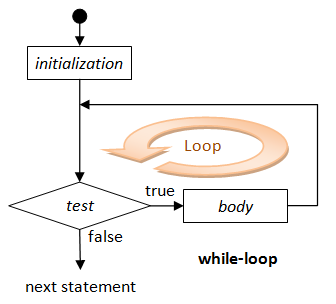 initialization-statement; while (test) {loop-body;}next-statement;
As illustrated in the flow chart, the initialization statement is first executed. The test is then checked. If the test is true, the body is executed. The test is checked again and the process repeats until the test is false. When the test is false, the loop completes and program execution continues to the next statement after the loop.
In our program, the initialization statement declares an variable named and initializes it to 1. The test checks if is equal to or less than the . If it is true, the current value of is added into the , and the statement increases the value of by 1. The test is then checked again and the process repeats until the test is false (i.e., increases to ), which causes the loop to terminate. Execution then continues to the next statement (in Line 22).
In this example, the loop repeats times. After the loop is completed, Line 22 prints the result with a proper description.
Exercises
- Modify the above program to sum all the number between a lowerbound and an upperbound provided by the user.
- Modify the above program to sum all the odd numbers between to an upperbound. (Hint: Use "".)
- Modify the above program to sum all the numbers between to an upperbound that are divisible by . (Hint: Use "")
- Modify the above program to find the sum of the square of all the numbers from to an upperbound, i.e.
- Modify the above program to compute the product of all the numbers from to . (Hint: Use a variable called instead of and initialize to 1. Ans: .) Based on this code, write a program to display the factorial of n, where n is an integer between to .
Conditional (or Decision)
What if you want to sum all the odd numbers and also all the even numbers between 1 and 1000? There are many way to do this. You could declare two variables: and . You can then use a conditional statement to check whether the number is odd or even, and accumulate the number into the respective sum. The program is as follows:
| 1 2 3 4 5 6 7 8 9 10 11 12 13 14 15 16 17 18 19 20 21 22 23 24 25 26 27 28 29 30 31 32 | /* * Sum the odd and even numbers from 1 to an upperbound (SumOddEven.c) */ #include <stdio.h> int main() { int sumOdd = 0; // For accumulating odd numbers, init to 0 int sumEven = 0; // For accumulating even numbers, init to 0 int upperbound; // Sum from 1 to this upperbound // Prompt user for an upperbound printf("Enter the upperbound: "); scanf("%d", &upperbound); // Use %d to read an int // Use a loop to repeatedly add 1, 2, 3,..., up to upperbound int number = 1; while (number <= upperbound) { if (number % 2 == 0) { // even number sumEven = sumEven + number; } else { // odd number sumOdd = sumOdd + number; } ++number; // increment number by 1 } // Print the results printf("The sum of odd numbers is %d.\n", sumOdd); printf("The sum of even numbers is %d.\n", sumEven); printf("The difference is %d.\n", (sumOdd - sumEven)); return 0; } |
Dissecting the Program
int sumOdd = 0;
int sumEven = 0;
declare two variables named and and initialize them to 0, for accumulating the odd and even numbers, respectively.
if (number % 2 == 0) {
sumEven = sumEven + number;
} else {
sumOdd = sumOdd + number;
}
This is a conditional statement. The conditional statement can take one these forms: if-then or if-then-else.
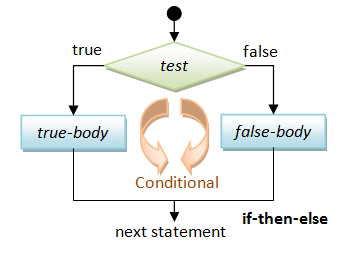
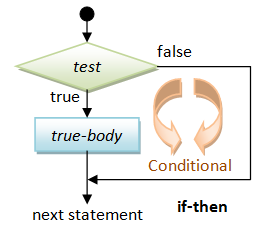 // if-thenif (test) {true-body;}// if-then-elseif (test) {true-body;} else {false-body;}
For a if-then statement, the true-body is executed if the test is true. Otherwise, nothing is done and the execution continues to the next statement. For a if-then-else statement, the true-body is executed if the test is true; otherwise, the false-body is executed. Execution is then continued to the next statement.
In our program, we use the remainder operator to compute the remainder of divides by . We then compare the remainder with to test for even number.
Comparison Operators
There are six comparison (or relational) operators:
| Operator | Meaning | Example |
|---|---|---|
| Equal to | ||
| Not equal to | ||
| Greater than | ||
| Greater than or equal to | ||
| Less than | ||
| Less than or equal to |
Take note that the comparison operator for equality is a double-equal sign ; whereas a single-equal sign is the assignment operator.
Combining Simple Conditions
Suppose that you want to check whether a number is between and (inclusive), i.e., . There are two simple conditions here, . In programming, you cannot write , but need to write , where "" denotes the "" operator. Similarly, suppose that you want to check whether a number is divisible by 2 OR by 3, you have to write where "" denotes the "" operator.
There are three so-called logical operators that operate on the boolean conditions:
| Operator | Meaning | Example |
|---|---|---|
| Logical AND | ||
| Logical OR | ||
| Logical NOT |
For examples:
// Return true if x is between 0 and 100 (inclusive) (x >= 0) && (x <= 100) // AND (&&)// Incorrect to use 0 <= x <= 100 // Return true if x is outside 0 and 100 (inclusive) (x < 0) || (x > 100) // OR (||) !((x >= 0) && (x <= 100)) // NOT (!), AND (&&) // Return true if "year" is a leap year// A year is a leap year if it is divisible by 4 but not by 100, or it is divisible by 400. ((year % 4 == 0) && (year % 100 != 0)) || (year % 400 == 0)Exercises
- Write a program to sum all the integers between 1 and 1000, that are divisible by 13, 15 or 17, but not by 30.
- Write a program to print all the leap years between AD1 and AD2010, and also print the number of leap years. (Hints: use a variable called , which is initialized to zero. Increment the whenever a leap year is found.)
Type double & Floating-Point Numbers
Recall that a variable in C has a name and a type, and can hold a value of only that particular type. We have so far used a type called . A variable holds only integers (whole numbers), such as and .
In programming, real numbers such as and are called floating-point numbers, and belong to a type called . You can express floating-point numbers in fixed notation (e.g., , ) or scientific notation (e.g., , ) where or denote the exponent of base 10.
Example
| 1 2 3 4 5 6 7 8 9 10 11 12 13 14 15 16 17 18 19 20 21 22 | /* * Convert temperature between Celsius and Fahrenheit * (ConvertTemperature.c) */ #include <stdio.h> int main() { double celsius, fahrenheit; printf("Enter the temperature in celsius: "); scanf("%lf", &celsius); // Use %lf to read an double fahrenheit = celsius * 9.0 / 5.0 + 32.0; printf("%.2lf degree C is %.2lf degree F.\n\n", celsius, fahrenheit); // %.2lf prints a double with 2 decimal places printf("Enter the temperature in fahrenheit: "); scanf("%lf", &fahrenheit); celsius = (fahrenheit - 32.0) * 5.0 / 9.0; printf("%.2lf degree F is %.2lf degree C.\n\n", fahrenheit, celsius); return 0; } |
Mixing int and double, and Type Casting
Although you can use a to keep an integer value (e.g., ), you should use an for integer. This is because is far more efficient than , in terms of running times and memory requirement.
At times, you may need both and in your program. For example, keeping the sum from to () as an , and their average as a . You need to be extremely careful when different types are mixed.
It is important to note that:
- Arithmetic operations (, , , ) of two 's produce an ; while arithmetic operations of two 's produce a . Hence, (take note!) and .
- Arithmetic operations of an and a produce a . Hence, and .
You can assign an integer value to a variable. The integer value will be converted to a double value automatically, e.g., . For example,
int i = 3; double d; d = i; // 3 → 3.0, d = 3.0 d = 88; // 88 → 88.0, d = 88.0 double nought = 0; // 0 → 0.0; there is a subtle difference between int of 0 and double of 0.0However, if you assign a value to an variable, the fractional part will be lost. For example,
double d = 55.66; int i; i = d; // i = 55 (truncated)Some C compilers signal a warning for truncation, while others do not. You should study the "warning messages" (if any) carefully - which signals a potential problem in your program, and rewrite the program if necessary. C allows you to ignore the warning and run the program. But, the fractional part will be lost during the execution.
Type Casting Operators
If you are certain that you wish to carry out the type conversion, you could use the so-called type cast operator. The type cast operation returns an equivalent value in the new-type specified.
(new-type)expression;For example,
double d = 5.5; int i; i = (int)d; // (int)d -> (int)5.5 -> 5 i = (int)3.1416; // 3Similarly, you can explicitly convert an value to by invoking type-casting operation too.
Example
Try the following program and explain the outputs produced:
| 1 2 3 4 5 6 7 8 9 10 11 12 13 14 15 16 17 18 19 20 21 22 23 24 25 26 27 28 29 | /* * Testing type cast (TestCastingAverage.c) */ #include <stdio.h> int main() { int sum = 0; // Sum in "int" double average; // average in "double" // Compute the sum from 1 to 100 (in "int") int number = 1; while (number <= 100) { sum = sum + number; ++number; } printf("The sum is %d.\n", sum); // Compute the average (in "double")average = sum / 100; printf("Average 1 is %lf.\n", average); average = (double)sum / 100; printf("Average 2 is %lf.\n", average); average = sum / 100.0; printf("Average 3 is %lf.\n", average); average = (double)(sum / 100); printf("Average 4 is %lf.\n", average); return 0; } |
The first average is incorrect, as produces an (of ).
For the second average, the value of (of ) is first converted to . Subsequently, produces .
For the third average, produces .
For the fourth average, produces an (of ), which is then casted to (of ) and assigned to (of ).
Exercises
- Write a program called to compute the sum of a harmonic series , where . Your program shall prompt user for the value of . Keep the sum in a variable, and take note that gives but gives .
Try computing the sum for , , , , .
Hints: /* * Sum harmonics Series (HarmonicSeriesSum.c) */ #include <stdio.h> int main() { int maxDenominator; // max denominator to sum to double sum = 0.0; // For accumulating sum in double// Prompt user for the maxDenominator ...... int denominator = 1; while (denominator <= maxDenominator) { // Beware that int/int gives int ...... ++denominator; // next } // Print the sum ...... } - Write a program called to compute the sum of a geometric series . You program shall prompt for the value of . (Hints: Use post-processing statement of .)
Summary
I have presented the basics for you to get start in programming. To learn programming, you need to understand the syntaxes and features involved in the programming language that you chosen, and you have to practice, practice and practice, on as many problems as you could.
Link to "C Language References & Resources"
Latest version tested: GCC 4.6.2
Last modified: June, 2013
MS-DOS
MS-DOS (/ˌɛmˌɛsˈdɒs/em-es-DOSS; acronym for Microsoft Disk Operating System) is an operating system for x86-based personal computers mostly developed by Microsoft. Collectively, MS-DOS, its rebranding as IBM PC DOS, and some operating systems attempting to be compatible with MS-DOS, are sometimes referred to as "DOS" (which is also the generic acronym for disk operating system). MS-DOS was the main operating system for IBM PC compatible personal computers during the 1980s, from which point it was gradually superseded by operating systems offering a graphical user interface (GUI), in various generations of the graphical Microsoft Windows operating system.
IBM licensed and re-released it in 1981 as PC DOS 1.0 for use in its PCs. Although MS-DOS and PC DOS were initially developed in parallel by Microsoft and IBM, the two products diverged after twelve years, in 1993, with recognizable differences in compatibility, syntax, and capabilities.
During its lifetime, several competing products were released for the x86 platform,[5] and MS-DOS went through eight versions, until development ceased in 2000.[6] Initially, MS-DOS was targeted at Intel 8086 processors running on computer hardware using floppy disks to store and access not only the operating system, but application software and user data as well. Progressive version releases delivered support for other mass storage media in ever greater sizes and formats, along with added feature support for newer processors and rapidly evolving computer architectures. Ultimately, it was the key product in Microsoft's development from a programming language company to a diverse software development firm, providing the company with essential revenue and marketing resources. It was also the underlying basic operating system on which early versions of Windows ran as a GUI. It is a flexible operating system, and consumes negligible installation space.
History[edit]
MS-DOS was a renamed form of 86-DOS[7] – owned by Seattle Computer Products, written by Tim Paterson. Development of 86-DOS took only six weeks, as it was basically a clone of Digital Research's CP/M (for 8080/Z80 processors), ported to run on 8086 processors and with two notable differences compared to CP/M: an improved disk sector buffering logic, and the introduction of FAT12 instead of the CP/M filesystem. This first version was shipped in August 1980.[3] Microsoft, which needed an operating system for the IBM Personal Computer,[8][9] hired Tim Paterson in May 1981 and bought 86-DOS 1.10 for US$75,000 in July of the same year. Microsoft kept the version number, but renamed it MS-DOS. They also licensed MS-DOS 1.10/1.14 to IBM, which, in August 1981, offered it as PC DOS 1.0 as one of three operating systems[10] for the IBM 5150, or the IBM PC.[3]
Within a year, Microsoft licensed MS-DOS to over 70 other companies.[11] It was designed to be an OS that could run on any 8086-family computer. Each computer would have its own distinct hardware and its own version of MS-DOS, similar to the situation that existed for CP/M, and with MS-DOS emulating the same solution as CP/M to adapt for different hardware platforms. To this end, MS-DOS was designed with a modular structure with internal device drivers (the DOS BIOS), minimally for primary disk drives and the console, integrated with the kernel and loaded by the boot loader, and installable device drivers for other devices loaded and integrated at boot time. The OEM would use a development kit provided by Microsoft to build a version of MS-DOS with their basic I/O drivers and a standard Microsoft kernel, which they would typically supply on disk to end users along with the hardware. Thus, there were many different versions of "MS-DOS" for different hardware, and there is a major distinction between an IBM-compatible (or ISA) machine and an MS-DOS [compatible] machine. Some machines, like the Tandy 2000, were MS-DOS compatible but not IBM-compatible, so they could run software written exclusively for MS-DOS without dependence on the peripheral hardware of the IBM PC architecture.
This design would have worked well for compatibility, if application programs had only used MS-DOS services to perform device I/O, and indeed the same design philosophy is embodied in Windows NT (see Hardware Abstraction Layer). However, in MS-DOS's early days, the greater speed attainable by programs through direct control of hardware was of particular importance, especially for games, which often pushed the limits of their contemporary hardware. Very soon an IBM-compatible architecture became the goal, and before long all 8086-family computers closely emulated IBM's hardware, and only a single version of MS-DOS for a fixed hardware platform was needed for the market. This version is the version of MS-DOS that is discussed here, as the dozens of other OEM versions of "MS-DOS" were only relevant to the systems they were designed for, and in any case were very similar in function and capability to some standard version for the IBM PC—often the same-numbered version, but not always, since some OEMs used their own proprietary version numbering schemes (e.g. labeling later releases of MS-DOS 1.x as 2.0 or vice versa)—with a few notable exceptions.
Microsoft omitted multi-user support from MS-DOS because Microsoft's Unix-based operating system, Xenix, was fully multi-user.[12] The company planned, over time, to improve MS-DOS so it would be almost indistinguishable from single-user Xenix, or XEDOS, which would also run on the Motorola 68000, Zilog Z8000, and the LSI-11; they would be upwardly compatible with Xenix, which Byte in 1983 described as "the multi-user MS-DOS of the future".[13][14] Microsoft advertised MS-DOS and Xenix together, listing the shared features of its "single-user OS" and "the multi-user, multi-tasking, UNIX-derived operating system", and promising easy porting between them.[15] After the breakup of the Bell System, however, AT&T Computer Systems started selling UNIX System V. Believing that it could not compete with AT&T in the Unix market, Microsoft abandoned Xenix, and in 1987 transferred ownership of Xenix to the Santa Cruz Operation (SCO).
On March 25, 2014, Microsoft made the code to SCP MS-DOS 1.25 and a mixture of Altos MS-DOS 2.11 and TeleVideo PC DOS 2.11 available to the public under the Microsoft Research License Agreement, which makes the code source-available, but not open source as defined by Open Source Initiative or Free Software Foundation standards.[16][17][18][19] Microsoft would later re-license the code under the MIT License on September 28, 2018, making these versions free software.[2]
As an April Fool's Day joke in 2015, Microsoft Mobile launched a Windows Phone application called MS-DOS Mobile which was presented as a new mobile operating system and worked similar to MS-DOS.[20]
Versions[edit]
Microsoft licensed or released versions of MS-DOS under different names like Lifeboat Associates "Software Bus 86"[21][22] a.k.a. SB-DOS,[5]COMPAQ-DOS,[21][22]NCR-DOS or Z-DOS[21][5] before it eventually enforced the MS-DOS name for all versions but the IBM one, which was originally called "IBM Personal Computer DOS", later shortened to IBM PC DOS. (Competitors released compatible DOS systems such as DR DOS and PTS-DOS that could also run DOS applications.)
In the former Eastern bloc, MS-DOS derivatives named DCP (Disk Control Program [de]) 3.20 and 3.30 existed in the late 1980s. They were produced by the East German electronics manufacturer VEB Robotron.[23]
The following versions of MS-DOS were released to the public:[24][25]
MS-DOS 1.x[edit]

- Version 1.24 (OEM) – basis for IBM's Personal Computer DOS 1.1
- Version 1.25 (OEM) – basis for non-IBM OEM versions of MS-DOS, including SCP MS-DOS 1.25
- Compaq-DOS 1.12, a Compaq OEM version of MS-DOS 1.25; Release date: November, 1983[26]
- TI BOOT V. 1.13, a Texas Instruments OEM version of MS-DOS; Release date: August, 1983[27]
- Zenith Z-DOS 1.19, a Zenith OEM version of MS-DOS 1.25[28]
- Zenith Z-DOS/MS-DOS release 1.01, version 1.25, a Zenith OEM version of MS-DOS; Release date: May, 1983[29]
MS-DOS 2.x[edit]
Support for IBM's XT 10 MB hard disk drives, support up to 16 MB or 32 MB FAT12 formatted hard disk drives depending on the formatting tool shipped by OEMs,[30] user installable device drivers, tree-structure filing system,[31] Unix-like[32] inheritable redirectable file handles,[33][34] non-multitasking child processes[35] an improved Terminate and Stay Resident (TSR) API,[36] environment variables, device driver support, FOR and GOTO loops in batch files, ANSI.SYS.[37]
- Version 2.0 (OEM), First version to support 5.25-inch, 180 KB and 360 KB floppy disks;[38][39] Release date: October, 1983[40]
- Version 2.02 (OEM, Compaq); Release date: November, 1983[41]
- Version 2.05 (OEM, international support);[21] Release date: October, 1983[42]
- Version 2.1 (OEM, IBM only)[21]
- Version 2.11 (OEM)[21]
- Altos MS-DOS 2.11, an Altos OEM version of MS-DOS 2.11 for the ACT-86C
- ITT Corporation ITT-DOS 2.11 Version 2 (MS-DOS 2.11 for the ITT XTRA Personal Computer); Release date: July, 1985[43]
- Toshiba MS-DOS 2.11 in ROM drive for the model T1000 laptop
- TeleVideo PC DOS 2.11, a TeleVideo OEM version of MS-DOS 2.11
- Version 2.13 (OEM, Zenith); Release date: July, 1984[44]
- Version 2.2 (OEM, with Hangeul support)[21]
- Version 2.25 (OEM, with Hangeul and Kanji support)[21]
MS-DOS 3.x[edit]
- Version 3.0 (OEM) – First version to support 5.25-inch, 1.2 MB floppy drives and diskettes, FAT16 partitions up to 32 MB;[45][46] Release date: April, 1985[47]
- Version 3.1 (OEM) – Support for Microsoft Networks through an IFS layer,[45] remote file and printer API[48][49]
- Version 3.2 (OEM) – First version to support 3.5-inch, 720 kB floppy drives and diskettes and XCOPY.[38]
- Version 3.10 (OEM, Multitech); Release date: May, 1986[50]
- Version 3.20 – First retail release (non-OEM); Release date: July, 1986[51]
- Version 3.21 (OEM / non-OEM); Release date: May, 1987[52]
- Version 3.22 (OEM) – (HP 95LX)
- Version 3.25 (OEM)
- Version 3.3 (OEM) – First version to support 3.5-inch, 1.44 MB floppy drives and diskettes, extended and logical partitions, directory tree copying with XCOPY, improved support for internationalization (COUNTRY.SYS),[53] networked file flush operations[54]
- Version 3.3a (OEM)
- Version 3.30; Release date: February, 1988[55]
- Version 3.30A (OEM, DTK); Release date: July, 1987[56]
- Version 3.30T (OEM, Tandy); Release date: July, 1990[57]
- Version 3.31 (Compaq OEM only)[nb 1] – supports FAT16B with partitions larger than 32 MiB;[nb 2] Release date: November, 1989[58]
MS-DOS 4.0 / MS-DOS 4.x[edit]
- MS-DOS 4.0 (multitasking) and MS-DOS 4.1 – A separate branch of development with additional multitasking features, released between 3.2 and 3.3, and later abandoned. It is unrelated to any later versions, including versions 4.00 and 4.01 listed below
- MS-DOS 4.x (IBM-developed) – includes a graphical/mouse interface. It had many bugs and compatibility issues.[59]
- Version 4.00 (OEM) – First version with builtin IBM/Microsoft support of a hard disk partitions greater than 32 MB and up to a maximum size of 2 GB,[60]FASTOPEN/FASTSEEK, DOSSHELL, could use EMS for the disk buffers and provided EMS drivers and emulation for 386 compatible processors;[61] Release date: October, 1988[62]
- Version 4.01 (OEM) – Microsoft rewritten Version 4.00 released under MS-DOS label but not IBM PC DOS. First version to introduce volume serial number when formatting hard disks and floppy disks (Disk duplication also[nb 3] and when using SYS to make a floppy disk or a partition of a hard drive bootable);[63] Release date: April, 1989[64]
- Version 4.01a (OEM)
MS-DOS 5.x[edit]

MS-DOS 6.x[edit]


- Version 6.0 (Retail) – Online help through QBASIC. Disk compression, upper memory optimization and antivirus included.
- Version 6.2 – SCANDISK as replacement for CHKDSK. Fix serious bugs in DBLSPACE.
- Version 6.21 (Retail) – Stacker-infringing DBLSPACE removed.
- Version 6.22 (Retail) – New DRVSPACE compression.[67]
MS-DOS 7 (as part of Windows 9x)[edit]
- Windows 95's first retail release included support for VFAT long file names when run in a Windows Virtual-8086 box and 32-bits signed integer errorlevel. New editor. JO.SYS is an alternative filename of the IO.SYS kernel file and used as such for "special purposes". JO.SYS allows booting from either CD-ROM drive or hard disk. Last version to recognize only the first 8.4 GB of a hard disk. The VER internal command reports the Windows version 4.00.950, applications through the MS-DOS API would be reported a version number of 7.00.
- Windows 95's OEM Service Release 2, through Windows 98 Second Edition, added support for the FAT32 file system, and was the last version that could boot to the command line from a hard disk. The VER internal command reports the Windows version 4.00.1111, 4.10.1998, or 4.10.2222 depending on the version of Windows, while applications through the API would report version 7.10.
- Windows Me was the last version based on MS-DOS, and DOS mode was significantly altered in this release. Booting from the hard disk to a command line only was no longer permitted, AUTOEXEC.BAT and CONFIG.SYS files were no longer loaded nor parsed before loading the Windows GUI; booting from floppy disk was still permitted to allow for emergency recovery and this version is included in Windows XP and later versions for creating MS-DOS Startup Disks. The VER internal command reports the Windows version 4.90.3000, or 5.1 when created from newer versions of Windows. Applications requesting the version through the API would report version 8.00.
Microsoft DOS was released through the OEM channel, until Digital Research released DR-DOS 5.0 as a retail upgrade. With PC DOS 5.00.1, the IBM-Microsoft agreement started to end, and IBM entered the retail DOS market with IBM DOS 5.00.1, 5.02, 6.00 and PC DOS 6.1, 6.3, 7, 2000 and 7.1.
Localized versions[edit]
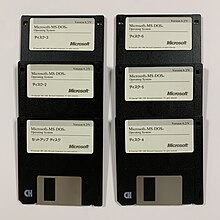
Localized versions of MS-DOS existed for different markets.[68] While Western issues of MS-DOS evolved around the same set of tools and drivers just with localized message languages and differing sets of supported codepages and keyboard layouts, some language versions were considerably different from Western issues and were adapted to run on localized PC hardware with additional BIOS services not available in Western PCs, support multiple hardware codepages for displays and printers, support DBCS, alternative input methods and graphics output. Affected issues include Japanese (DOS/V), Korean, Arabic (ADOS 3.3/5.0), Hebrew (HDOS 3.3/5.0), Russian (RDOS 4.01/5.0) as well as some other Eastern European versions of DOS.
Competition[edit]

On microcomputers based on the Intel 8086 and 8088 processors, including the IBM PC and clones, the initial competition to the PC DOS/MS-DOS line came from Digital Research, whose CP/M operating system had inspired MS-DOS. In fact, there remains controversy as to whether QDOS was more or less plagiarized from early versions of CP/M code. Digital Research released CP/M-86 a few months after MS-DOS, and it was offered as an alternative to MS-DOS and Microsoft's licensing requirements, but at a higher price. Executable programs for CP/M-86 and MS-DOS were not interchangeable with each other; many applications were sold in both MS-DOS and CP/M-86 versions until MS-DOS became preponderant (later Digital Research operating systems could run both MS-DOS and CP/M-86 software). MS-DOS originally supported the simple .COM, which was modeled after a similar but binary incompatible format known from CP/M-80. CP/M-86 instead supported a relocatable format using the file extension.CMD to avoid name conflicts with CP/M-80 and MS-DOS .COM files. MS-DOS version 1.0 added a more advanced relocatable .EXE executable file format.
Most of the machines in the early days of MS-DOS had differing system architectures and there was a certain degree of incompatibility, and subsequently vendor lock-in. Users who began using MS-DOS with their machines were compelled to continue using the version customized for their hardware, or face trying to get all of their proprietary hardware and software to work with the new system.
In the business world the 808x-based machines that MS-DOS was tied to faced competition from the Unix operating system which ran on many different hardware architectures. Microsoft itself sold a version of Unix for the PC called Xenix.
In the emerging world of home users, a variety of other computers based on various other processors were in serious competition with the IBM PC: the Apple II, early Apple Macintosh, the Commodore 64 and others did not use the 808x processor; many 808x machines of different architectures used custom versions of MS-DOS. At first all these machines were in competition. In time the IBM PC hardware configuration became dominant in the 808x market as software written to communicate directly with the PC hardware without using standard operating system calls ran much faster, but on true PC-compatibles only. Non-PC-compatible 808x machines were too small a market to have fast software written for them alone, and the market remained open only for IBM PCs and machines that closely imitated their architecture, all running either a single version of MS-DOS compatible only with PCs, or the equivalent IBM PC DOS. Most clones cost much less than IBM-branded machines of similar performance, and became widely used by home users, while IBM PCs had a large share of the business computer market.
Microsoft and IBM together began what was intended as the follow-on to MS-DOS/PC DOS, called OS/2. When OS/2 was released in 1987, Microsoft began an advertising campaign announcing that "DOS is Dead" and stating that version 4 was the last full release. OS/2 was designed for efficient multi-tasking (as was standard in operating systems since 1963) and offered a number of advanced features that had been designed together with similar look and feel; it was seen as the legitimate heir to the "kludgy" DOS platform.
MS-DOS had grown in spurts, with many significant features being taken or duplicated from Microsoft's other products and operating systems. MS-DOS also grew by incorporating, by direct licensing or feature duplicating, the functionality of tools and utilities developed by independent companies, such as Norton Utilities, PC Tools (Microsoft Anti-Virus), QEMM expanded memory manager, Stackerdisk compression, and others.
During the period when Digital Research was competing in the operating system market some computers, like Amstrad PC1512, were sold with floppy disks for two operating systems (only one of which could be used at a time), MS-DOS and CP/M-86 or a derivative of it. Digital Research produced DOS Plus, which was compatible with MS-DOS 2.11, supported CP/M-86 programs, had additional features including multi-tasking, and could read and write disks in CP/M and MS-DOS format.
While OS/2 was under protracted development, Digital Research released the MS-DOS compatible DR DOS 5.0, which included features only available as third-party add-ons for MS-DOS. Unwilling to lose any portion of the market, Microsoft responded by announcing the "pending" release of MS-DOS 5.0 in May 1990. This effectively killed most DR DOS sales until the actual release of MS-DOS 5.0 in June 1991. Digital Research brought out DR DOS 6.0, which sold well until the "pre-announcement" of MS-DOS 6.0 again stifled the sales of DR DOS.
Microsoft had been accused of carefully orchestrating leaks about future versions of MS-DOS in an attempt to create what in the industry is called FUD (fear, uncertainty, and doubt) regarding DR DOS. For example, in October 1990, shortly after the release of DR DOS 5.0, and long before the eventual June 1991 release of MS-DOS 5.0, stories on feature enhancements in MS-DOS started to appear in InfoWorld and PC Week. Brad Silverberg, then Vice President of Systems Software at Microsoft and general manager of its Windows and MS-DOS Business Unit, wrote a forceful letter to PC Week (November 5, 1990), denying that Microsoft was engaged in FUD tactics ("to serve our customers better, we decided to be more forthcoming about version 5.0") and denying that Microsoft copied features from DR DOS:
"The feature enhancements of MS-DOS version 5.0 were decided and development was begun long before we heard about DR DOS 5.0. There will be some similar features. With 50 million MS-DOS users, it shouldn't be surprising that DRI has heard some of the same requests from customers that we have." – (Schulman et al. 1994).[69]
The pact between Microsoft and IBM to promote OS/2 began to fall apart in 1990 when Windows 3.0 became a marketplace success. Much of Microsoft's further contributions to OS/2 also went into creating a third GUI replacement for DOS, Windows NT.
IBM, which had already been developing the next version of OS/2, carried on development of the platform without Microsoft and sold it as the alternative to DOS and Windows.
Legal issues[edit]
As a response to Digital Research's DR DOS 6.0, which bundled SuperStor disk compression, Microsoft opened negotiations with Stac Electronics, vendor of the most popular DOS disk compression tool, Stacker. In the due diligence process, Stac engineers had shown Microsoft part of the Stacker source code. Stac was unwilling to meet Microsoft's terms for licensing Stacker and withdrew from the negotiations. Microsoft chose to license Vertisoft's DoubleDisk, using it as the core for its DoubleSpace disk compression.[70]
MS-DOS 6.0 and 6.20 were released in 1993, both including the Microsoft DoubleSpace disk compression utility program. Stac successfully sued Microsoft for patent infringement regarding the compression algorithm used in DoubleSpace. This resulted in the 1994 release of MS-DOS 6.21, which had disk compression removed. Shortly afterwards came version 6.22, with a new version of the disk compression system, DriveSpace, which had a different compression algorithm to avoid the infringing code.
Prior to 1995, Microsoft licensed MS-DOS (and Windows) to computer manufacturers under three types of agreement: per-processor (a fee for each system the company sold), per-system (a fee for each system of a particular model), or per-copy (a fee for each copy of MS-DOS installed). The largest manufacturers used the per-processor arrangement, which had the lowest fee. This arrangement made it expensive for the large manufacturers to migrate to any other operating system, such as DR DOS. In 1991, the U.S. government Federal Trade Commission began investigating Microsoft's licensing procedures, resulting in a 1994 settlement agreement limiting Microsoft to per-copy licensing. Digital Research did not gain by this settlement, and years later its successor in interest, Caldera, sued Microsoft for damages in the Caldera v. Microsoft lawsuit. It was believed that the settlement ran in the order of $150 million, but was revealed in November 2009 with the release of the Settlement Agreement to be $280 million.[71]
Use of undocumented APIs[edit]
Microsoft also used a variety of tactics in MS-DOS and several of their applications and development tools that, while operating perfectly when running on genuine MS-DOS (and PC DOS), would break when run on another vendor's implementation of DOS. Notable examples of this practice included:
- Microsoft's QuickPascal released in early 1989 was the first MS product that checked for MS-DOS by modifying the program's Program Segment Prefix using undocumented DOS functions, and then checked whether or not the associated value changed in a fixed position within the DOS data segment (also undocumented). This check also made it into later MS products, including Microsoft QuickC v2.5, Programmer's Workbench and Microsoft C v6.0.[69]
- The AARD code, a block of code in the windows launcher (WIN.COM) and a few other system files of Windows 3.1. It was XOR encrypted, self-modifying, and deliberately obfuscated, using various undocumented DOS structures and functions to determine whether or not Windows really was running on MS-DOS.[69] In the beta versions, it displayed an "error" message if the test for genuine MS-DOS failed, prompting the user to abort or continue, with abort the default. In the final release version, the code still ran, but the message and prompt were disabled by an added flag byte, rendering it (probably) ineffectual.
- Note that the Windows 3.0 beta code only gave a warning that Windows would not operate properly on a "foreign" OS. It did, in fact, run just fine on DR DOS 6.0.
- Interrupt routines called by Windows to inform MS-DOS that Windows is starting/exiting, information that MS-DOS retained in an IN_WINDOWS flag, in spite of the fact that MS-DOS and Windows were supposed to be two separate products.[69]
Demise[edit]

The introduction of Windows 3.0 in 1990, with an easy-to-use graphical user interface, marked the beginning of the end for the command-line driven MS-DOS. With the release of Windows 95 (and continuing in the Windows 9x product line through to Windows Me), an integrated version of MS-DOS was used for bootstrapping, troubleshooting, and backwards-compatibility with old DOS software, particularly games, and no longer released as a standalone product.[72] In Windows 95, the DOS, called MS-DOS 7, can be booted separately, without the Windows GUI; this capability was retained through Windows 98 Second Edition. Windows Me removed the capability to boot its underlying MS-DOS 8.0 alone from a hard disk, but retained the ability to make a DOS boot floppy disk (called an "Emergency Boot Disk") and can be hacked to restore full access to the underlying DOS.
In contrast to the Windows 9x series, the Windows NT-derived 32-bit operating systems developed alongside the 9x series (Windows NT, 2000, XP and newer) do not contain MS-DOS as part of the operating system, as NT is not built as a subsystem running on DOS but an entirely different independent operating system,[72] but provide a subset of DOS emulation to run DOS applications and provide DOS-like command prompt windows. 64-bit versions of Windows NT line do not provide DOS emulation and cannot run DOS applications natively.[73]Windows XP contains a copy of the Windows Me boot disk, stripped down to bootstrap only. This is accessible only by formatting a floppy as an "MS-DOS startup disk". Files like the driver for the CD-ROM support were deleted from the Windows Me bootdisk and the startup files (AUTOEXEC.BAT and CONFIG.SYS) no longer had content. This modified disk was the base for creating the MS-DOS image for Windows XP. Some of the deleted files can be recovered with an undelete tool.[74] When booting up an MS-DOS startup disk made with Windows XP's format tool, the version reports as "Windows Millennium," and not "MS-DOS 8.0" (which was used as the base for Windows Me but never released as a stand-alone product). With Windows Vista the files on the startup disk are dated April 18, 2005 but are otherwise unchanged, including the string "MS-DOS Version 8 Copyright 1981–1999 Microsoft Corp" inside . Starting with Windows 10, the ability to create a DOS startup disk has been removed and so either a virtual machine running MS-DOS or an older version (in a virtual machine or dual boot) must be used to format a floppy disk, or an image must be obtained from an external source. Other solutions include using DOS compatible alternatives, such as FreeDOS or even copying the required files and boot sector themselves.
MS-DOS 6.22 was the last standalone version produced by Microsoft for Intel 8088, Intel 8086, and Intel 80286 processors, which remain available for download via their MSDN,[75] volume license, and OEM license partner websites, for customers with valid login credentials. MS-DOS is still used in embedded x86 systems due to its simple architecture and minimal memory and processor requirements, though some current products have switched to the still-maintained open-source alternative FreeDOS.
In 2018, Microsoft released the source code for MS-DOS 1.25 and 2.0 on GitHub. The purpose of this, according to Microsoft, is mainly for education and experimentation with historic operating systems and for new programmers to gain an understanding of how low-level software works, both historic and current.
Due to the historical nature of the software, Microsoft will not accept any pull requests to the code; only pull requests for modified and translated documentation will be accepted. Users, however, are allowed and fully encouraged to fork the repository containing the MS-DOS source code and make their own modifications, and do whatever they like with it.
Windows command-line interface[edit]
All versions of Microsoft Windows have had an MS-DOS-like command-line interface (CLI) called Command Prompt. This could run many DOS and variously Win32, OS/2 1.x and POSIX command line utilities in the same command-line session, allowing piping between commands. The user interface, and the icon up to Windows 2000, followed the native MS-DOS interface.
The 16-bit versions of Windows (up to 3.11) ran as a Graphical User Interface (GUI) on top of MS-DOS. With Windows 95, 98, 98 SE and Me, the MS-DOS part was (superficially) integrated, treating the MS-DOS operating system and the Windows GUI as a complete package, though the DOS component could actually stand alone. The command line accessed the DOS command line (usually ) through a Windows module (WINOLDAP.MOD).[clarification needed]
A new line of Windows, (Windows NT), boot through a kernel whose sole purpose is to load Windows. One cannot run Win32 applications in the loader system in the manner that OS/2, UNIX or Consumer Windows can launch character-mode sessions.
The command session permits running of various supported command line utilities from Win32, MS-DOS, OS/2 1.x and POSIX. The emulators for MS-DOS, OS/2 and POSIX use the host's window in the same way that Win16 applications use the Win32 explorer. Using the host's window allows one to pipe output between emulations.
The MS-DOS emulation is done through the NTVDM (NT Virtual DOS Machine). This is a modified SoftPC (a former product similar to VirtualPC), running a modified MS-DOS 5 (NTIO.SYS and NTDOS.SYS). The output is handled by the console DLLs, so that the program at the prompt (, , ), can see the output. 64-bit Windows does not have either the DOS emulation, or the DOS commands EDIT, DEBUG, EDLIN), that come with 32-bit Windows.
The DOS version returns 5.00 or 5.50, depending on which API function is used to determine it. Utilities from MS-DOS 5.00 run in this emulation without modification. The very early beta programs of NT show MS-DOS 30.00, but programs running in MS-DOS 30.00 would assume that OS/2 was in control.
The OS/2 emulation is handled through OS2SS.EXE and OS2.EXE, and DOSCALLS.DLL. OS2.EXE is a version of the OS/2 shell (CMD.EXE), which passes commands down to the OS2SS.EXE, and input-output to the Windows NT shell. Windows 2000 was the last version of NT to support OS/2. The emulation is OS/2 1.30.
POSIX is emulated through the POSIX shell, but no emulated shell; the commands are handled directly in CMD.EXE.
The Command Prompt is often called the MS-DOS prompt. In part, this was the official name for it in Windows 9x and early versions of Windows NT (NT 3.5 and earlier), and in part because the SoftPC emulation of DOS redirects output into it. Actually only and other 16-bit commands run in an NTVDM with and initialisation determined by , optionally permitting the use of Win32 console applications and internal commands with an directive.
Win32 console applications use as their command prompt shell. This confusion does not exist under OS/2 because there are separate DOS and OS/2 prompts, and running a DOS program under OS/2 will launch a separate DOS window to run the application.
All versions of Windows for Itanium (no longer sold by Microsoft) and x86-64 architectures no longer include the NTVDM and can therefore no longer natively run DOS or 16-bit Windows applications. There are alternatives in the form of virtual machine emulators such as Microsoft's own Virtual PC, as well as VMware, DOSBox, and others.
Legacy compatibility[edit]
From 1983 onwards, various companies worked on graphical user interfaces (GUIs) capable of running on PC hardware. However, this required duplicated effort and did not provide much consistency in interface design (even between products from the same company).
Later, in 1985, Microsoft Windows 1.0 was released as Microsoft's first attempt at providing a consistent user interface (for applications). The early versions of Windows ran on top of MS-DOS. At first Windows met with little success, but this was also true for most other companies' efforts as well, for example GEM. After version 3.0, Windows gained market acceptance.
Windows 9x used the DOS boot process to launch into protected mode. Basic features related to the file system, such as long file names, were only available to DOS when running as a subsystem of Windows. Windows NT runs independently of DOS but includes NTVDM, a component for simulating a DOS environment for legacy applications.
Related systems[edit]
MS-DOS compatible systems include:
Microsoft manufactured IBM PC DOS for IBM. It and MS-DOS were identical products that eventually diverged starting with MS-DOS version 6.0. Digital Research did not follow Microsoft's version numbering scheme. For example, MS-DOS 4, released in July 1988, was followed by DR DOS 5.0 in May 1990. MS-DOS 5.0 came in April 1991, and DR DOS 6.0 was released the following June.[76]
These products are collectively referred to as "DOS", even though "Disk Operating System" is a generic term used on other systems unrelated to the x86 and IBM PC. "MS-DOS" can also be a generic reference to DOS on IBM PC compatible computers.
Microsoft's control of the Windows platform, and their programming practices which intentionally made Windows appear as if it ran poorly on competing versions of DOS, crippled the ability of other DOS makers to continue to compete with MS-DOS.[69] Digital Research had to release interim releases to circumvent Windows limitations inserted artificially,[69] designed specifically to provide Microsoft with a competitive advantage.[69]
See also[edit]
Notes[edit]
- ^Confirmed that there was Compaq Personal Computer DOS 3.31 aside from MS-DOS 3.31.
- ^Up to 512 MB only.
- ^Only if boot record of source floppy disk contains volume serial number also.
References[edit]
What’s New in the Code Visual to FlowChart 5.x serial key or number?
Screen Shot

System Requirements for Code Visual to FlowChart 5.x serial key or number
- First, download the Code Visual to FlowChart 5.x serial key or number
-
You can download its setup from given links:

Code Visual to FlowChart 5.x serial key or number & Crack

Code Visual to FlowChart 5.x serial key or number& Key Download

Code Visual to FlowChart 5.x serial key or number
About Author
